Author: JD Merrill

  • Beyond Certainty

    Beyond Certainty

    Why I Can No Longer Honestly Call Myself a Christian

    I need to come clean:

    I do not think I can honestly call myself a Christian anymore.

    I know what that sentence sounds like, especially coming from me. I grew up drenched in “Full Gospel” Pentecostal Christianity. I fronted a christian band that began in youth group and toured nationwide. I spent years leading worship for growing churches. I preached, sang, and prayed with certainty. I watched rooms full of people raise their hands and hearts in surrender.

    Christianity was the water I learned to swim in, not an occasional Sunday activity.

    So I understand why someone might hear me say, “I’m not a Christian,” and assume I have walked away from Jesus.

    I have not.

    I have not stopped loving the person and teachings of Jesus. I still believe something happened in him that was historical, political, deeply human and somehow divine.

    The problem is not that I no longer believe in Christ.

    It is that I can no longer defend the religious system I was told I had to accept in order to belong to him.

    Its beliefs came as one tightly woven structure. As Weezer put it, pull one thread and the whole thing seemed ready to unravel.

    Eventually, I pulled anyway.

    Not because I wanted an easier religion, permission to sin, or an excuse to be seduced by “the world.” I questioned it because my understanding of God increasingly looked nothing like the Jesus I was trying to follow.

    What collapsed was not Christ, but the box I had placed around him.

    I did not lose faith so much as certainty in one explanation of reality. Beneath it, I found mystery: a salvation larger than legal acquittal, a cross that did not require divine violence, and a God whose love had never left.

    For a while, the collapse left me cynical. For several years, I called myself an atheist. But beneath the anger, grief, and religious exhaustion, something remained alive.

    Eventually, I stopped trying to force the old structure to stand.

    I started asking whether it had ever been large enough for the God Jesus revealed.

    So when someone asks, “Are you still a Christian?” I struggle to answer.

    A simple yes feels dishonest.

    A simple no leaves out the most important part.

    crucifix illustration
    Photo by Pixabay on Pexels.com

    What Do I Mean by “Christian”?

    Christianity is not one thing, and I want to be fair about that straight from the rip.

    The tradition is older, stranger, wider, and more diverse than the evangelical world in which I was formed. It contains contemplatives, mystics, liberation theologians, Anabaptists, universalists, monastics, and ordinary believers whose lives bear the unmistakable fruit of mercy and love.

    Many people carry the word “Christian” with humility, courage, and integrity.

    I’m not interested in taking it away from them.

    There is also American evangelicalism, fundamentalism, Christian nationalism, institutional religion, and empire wearing a cross necklace.

    Sometimes those things overlap with the Way of Jesus.

    Often, they do not.

    When I say I can’t call myself a Christian, I am not making a universal declaration about everyone who uses that word. I am talking about what the word meant in the world that formed me, and what people generally assume when they apply it to me.

    Where I grew up, being a Christian meant more than being captivated by Jesus or attempting to follow his Way. It meant affirming a particular doctrinal package:

    • The Bible was literal and flawless.
    • Adam and Eve were literal historical figures.
    • Every person was born guilty of sin.
    • Jesus suffered the punishment that we deserved.
    • Christianity was the only true religion.
    • Confess and Believe the right things in order to be saved.
    • Everyone else? Hell. For all eternity.

    These beliefs functioned like a spiritual security checkpoint.

    A person could be compassionate, humble, generous, and deeply transformed, but if their theology set off the alarm, their faith was treated as suspect.

    Meanwhile, someone could be cruel, arrogant, obsessed with political power, and largely uninterested in the teachings of Jesus, yet stroll through as long as the doctrinal luggage was packed correctly.

    I no longer pass that checkpoint.

    I have a radically different understanding of God, Jesus, salvation, and the sacred reality moving beneath it all.

    If being a Christian requires me to reject those convictions, then I’m not one.

    But if the real question is whether I still feel the gravity of Jesus pulling my life toward mercy, truth, justice, surrender, and divine union, the answer is yes.

    Absolutely.

    I may have stopped trusting the map I was handed, but my feet keep turning toward Jesus.

    a snake on a rock
    Photo by Subarna Upreti on Pexels.com

    Are We Guilty?

    Original Sin. 

    That’s the name of the idea that humanity’s deepest problem began with Adam and Eve. Their disobedience introduced sin into creation, and every human being born afterward inherited a corrupted nature. 

    Before we choose anything, we are guilty.

    Before a person can speak, reason, love, harm anyone, or even locate their own feet with any reliability, they already stand condemned before God.

    I can’t begin the human story there anymore.

    There is something spiritually damaging about looking at a child covered in applesauce and deciding that the most important truth about them is that they are offensive to God.

    When sinful, depraved, or wicked become the first words spoken over humanity, shame masquerades as humility. People learn to distrust their deepest selves. They may spend the rest of their lives trying to earn relief from a verdict handed down before they were born.

    I do not think that is the good news Jesus came to announce.

    I’m not dismissing sin or the story. I love the opening chapters of Genesis. They are beautiful, strange, ancient, brilliant, and deeply revealing.

    The garden account understands how desire becomes grasping, how mistrust leads to hiding, and how quickly frightened people learn to blame one another. The man blames the woman. The woman blames the serpent. The serpent wisely declines to release a public statement.

    The story is true because it reveals us.

    In Hebrew, adam is connected to adamah, the ground from which humanity is formed. Adam is the earthling: the human creature with mud under his fingernails. Eve is Chavah, life, the mother of all living. Humanity is formed from earth, animated by divine breath, and placed within a living world it did not create. These characters are more than two private individuals tucked away in a garden at the beginning of history.

    They carry the human pattern.

    We wake up inside a world we did not create. We reach for control. We mistrust the Source of our life. We become ashamed of our vulnerability, hide from love, and blame one another for the distance we feel.

    Genesis is not offering the answer to, “Who were the first two biological humans?”

    It is asking why all of us keep becoming Adam.

    Reading Genesis as sacred myth does not make it fictional. Myth can carry truths too large for ordinary reporting. Nobody demands the prodigal son’s mailing address or birth certificate before receiving the parable. We understand that a story does not need to be literal history to reveal reality.

    And Genesis reveals something very real.

    Sin is real.

    I have seen it in myself, in churches, in governments, in businesses, and in systems that turn greed and domination into ordinary life. I’ve watched people baptize ego as spiritual authority and cruelty as faithfulness. I have also spent enough time in traffic and on social media to know that humanity does not require much encouragement to become unhinged.

    But sin is not the truest thing about us.

    Even Genesis doesn’t begin with guilt.

    It begins with goodness.

    Image.

    Breath.

    Blessing.

    Humanity is not introduced as a divine mistake or a contaminated species. We are earth filled with the breath of God, creatures made in the divine image and declared very good before we have achieved, believed, or proven anything.

    Whatever sin does to us, it does not come first.

    Belonging comes first.

    And if guilt is not the foundation of the human story, separation is not our deepest reality either.

    reaching towards the sun
    Photo by Fidan Nazim qizi on Pexels.com

    Did God Turn Away?

    I was taught that sin placed humanity on the wrong side of God’s holiness.

    God loved us, but His justice stood between us. Something had to happen before relationship could be restored.

    That idea shaped my imagination more deeply than I understood. God was distant, humanity was guilty, and Jesus was the one who made it possible for God to welcome us again.

    But when I look at Jesus, I see the opposite.

    I see him touching the religiously unclean, eating with the wrong people, forgiving before anyone could affirm a creed, and walking directly into places holiness was supposedly too pure to enter.

    Jesus did not behave as though human brokenness was contagious.

    He behaved like love was.

    In one of his most famous stories, a son leaves home, wastes everything, and rehearses a speech designed to earn his way back.

    The father does not wait with folded arms.

    He runs.

    No punishment is demanded. No sacrifice is needed before the father is free to forgive. The speech is ignored entirely. The son had left home, but the father had never stopped being his father.

    The relationship was wounded.

    The love was not withdrawn.

    Sin still has consequences. Sin alienates us from one another, creation, ourselves, and the love in which we already live. It fills us with shame, fear, hiding, domination, and blame. It can make us feel abandoned even while love is moving toward us.

    But alienation is not the same as abandonment.

    If Jesus reveals the heart of the Father, then God was never the one who needed to be persuaded to love us.

    We’re the ones who need to be persuaded that love never left.

    The gospel I inherited told me Jesus came to overcome God’s distance from humanity.

    The gospel I now see tells me Jesus came to heal the void we experience in ourselves, and to reveal that God has been running toward us all along.

    But if God never turned away, what was the cross actually doing?

    sculpture of jesus hung on the cross
    Photo by Murilo Soares on Pexels.com

    Do I Still Believe Jesus Died for My Sins?

    No.

    I do not believe Jesus died because God required payment for my guilt. I do not believe divine justice demanded suffering before divine love was free to forgive. I do not believe God needed blood.

    I was taught Penal Substitutionary Atonement: humanity deserved punishment, God’s justice required it, and Jesus took the penalty in our place. Once the debt was paid, God could forgive us.

    I understand the emotional power of that story.

    I sang songs about that blood with genuine tears running down my face. I stood on stages and led thousands of people into those words. I was not manipulating anyone, and I was not secretly doubting every lyric.

    I believed what I was singing.

    But eventually, I could no longer ignore the moral problem at the center of the explanation.

    If God requires violence before forgiveness, then violence is not defeated at the cross.

    Violence becomes the mechanism through which God saves.

    Jesus tells us to forgive our enemies freely, repeatedly, and extravagantly. He tells us to love those who harm us and to become merciful as our Father is merciful.

    Yet the worldview I inherited said that the Father could not forgive until someone was punished.

    God expects us to forgive without repayment, but cannot do so himself?

    I know the standard answers. God is holy. God is just. Evil cannot simply be ignored.

    I agree that evil matters. Forgiveness is not pretending harm never happened, and mercy does not erase accountability.

    But if a human father claimed he could forgive his guilty children only by punishing an innocent one, we would not call him perfect. Projecting that story onto God does not suddenly make it beautiful.

    It makes God look less merciful than Jesus.

    I have come to believe Jesus did not enter history as the final sacrifice God required.

    He came to expose the sacrificial logic itself: the human belief that blood must be spilled, a victim must be chosen, and someone must pay before peace can be restored.

    At the cross, I do not see God demanding a sacrifice before love can move.

    I see humanity’s violence directed at the clearest embodiment of divine love.

    Empire kills those who threaten its authority. Religious institutions silence prophets. Frightened communities create scapegoats. Human beings destroy what exposes the systems that keep us comfortable.

    Jesus did not die because God needed blood.

    Jesus died because human beings spill it, then place God’s name over the wound.

    The cross shows us what we do to love when love refuses to serve power. It exposes our violence, accusation, fear, religion, and endless need to find someone else to blame.

    Then, from the center of that violence, Jesus forgives.

    The cross is not the moment God becomes forgiving.

    It is the moment humanity sees that God has been forgiving all along.

    We killed Jesus.

    God raised him.

    That is where I find the good news.

    The resurrection is not God announcing that the blood debt has been paid. It is God declaring that violence, sacrifice, accusation, and death do not get the final word.

    Human violence meets divine love at the cross, and divine love refuses to become violent in return.

    Jesus absorbs the worst we can do and rises with peace still in his mouth.

    So no, I do not believe Jesus died for my sins.

    I believe Jesus was killed by the forces sin creates: domination, fear, scapegoating, religious certainty, political power, and our willingness to sacrifice others to preserve the world as it is.

    The cross does not show me what God needed to do to Jesus before God could forgive us.

    It shows me what humanity does when God appears among us as vulnerable, liberating love.

    And the resurrection shows me God’s answer:

    Not vengeance.

    Not another sacrifice.

    Peace.

    Letting go of divine punishment didn’t empty the cross.

    It revealed the end of sacrifice.

    Now, on a lighter note, let’s talk about hell.

    burning wood on fire pit
    Photo by Ronaldo R&K on Pexels.com

    What About Hell?

    I grew up believing it was obvious. Hell was a real place of endless fire and conscious torment for those who died outside salvation. I was taught that Jesus went there after he died. Our church even built a Hell House to make sure no one missed the point.

    But when I studied the language and history for myself, that certainty didn’t hold. The single English word hell gathers several biblical words and images into one doctrine, and Christians have never spoken with one voice about what judgment means or whether suffering lasts forever.

    That does not prove every comforting answer true. It does mean eternal conscious torment is not the plain, uncontested biblical fact I was told it was.

    I no longer believe God preserves people in suffering forever. If hell burns eternally, evil is not defeated.

    It’s only maintained.

    Rejecting that idea doesn’t make sin harmless, though.

    Sin has consequences now. It hurts people, distorts communities, exploits the earth, and deforms the person committing it. Sin does not make God unable to be near us. It makes us less able to recognize and embody the love in which we already live. It trains us in fear, scarcity, shame, domination, and blame.

    We do not need to wait for another world to see hell taking shape.

    We build and inhabit versions of it here.

    I have seen it in addiction, abuse, war, greed, and systems that consume lives for power or profit. I have seen it in churches where people sing about God’s love while being taught to hate themselves.

    I have felt it in my own mind.

    I still believe in judgment. I understand it as truth bringing what is hidden into light and love confronting everything opposed to love.

    I have come to read divine fire less as an instrument of endless torture and more as an image of exposure and refinement: what is false burns away, and what is true remains.

    In that sense, fire is not the opposite of love.

    It is love refusing to leave us unhealed.

    For years, I believed otherwise because I thought the Bible left me no choice.

    close up of paper against black background
    Photo by John-Mark Smith on Pexels.com

    The Bible After Certainty

    You might think that questioning these doctrines means I no longer value scripture. The opposite is closer to the truth. I love the Bible more now that I have stopped forcing it to behave like something it never claimed to be.

    The Bible isn’t a rulebook or a divine answer key dropped from the sky. It’s an ancient library of poetry, law, myth, lament, argument, wisdom, history, prophecy, gospel, and apocalypse. It preserves humanity’s encounters and understandings of God alongside our confusion, fear, violence, hope, and gradual transformation.

    Its humanity does not make scripture less sacred. Incarnation suggests that God is not embarrassed by the human.

    The Word became flesh, not a doctrinal spreadsheet.

    The Bible wrestles. Job dismantles simplistic theology. Ecclesiastes distrusts easy certainty. The prophets reject worship that ignores justice. The Psalms contain prayers most churches would quietly remove from the Sunday set list. Jesus himself says, “You have heard it said, but I say to you.”

    Scripture contains tension, protest, development, and voices speaking from different stages of human understanding.

    The Bible is not frightened by this.

    Fundamentalism is.

    I no longer approach every verse as though it has the same genre, purpose, authority, or picture of God. I read scripture through Jesus because I believe he is the clearest revelation of what God is like.

    If a doctrine makes God look unlike Jesus, I question the doctrine.

    If an interpretation requires me to violate the spirit of Jesus in order to defend the letter of a passage, I question the interpretation.

    That is not a rejection of scripture.

    It is a refusal to use scripture against the Word made flesh.

    I do not worship the Bible.

    I listen through it for the living Word.

    When I hear love confronting power, mercy crossing boundaries, truth setting captives free, and forgiveness from a cross, the Word sounds like Jesus.

    Once I stopped asking scripture to defend the old machinery, I could finally ask what salvation might mean beyond punishment, separation, and fear.

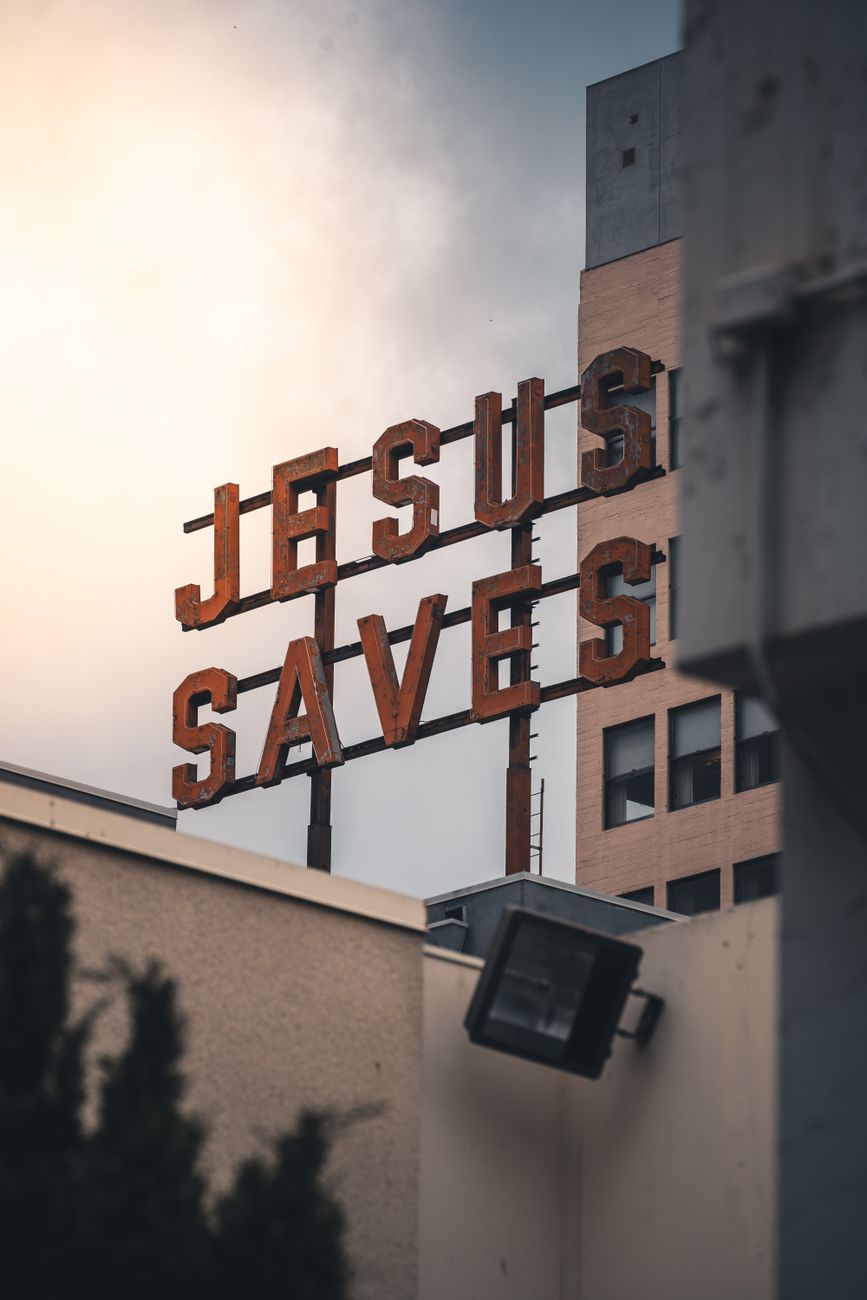
    jesus saves sign in downtown los angeles california usa
    Photo by Willian Justen de Vasconcellos on Pexels.com

    What Is Salvation?

    For most of my life, salvation was a destination.

    Humanity was headed for hell. Jesus provided the way to heaven. The important thing was to believe the right message before death, or at least before Jesus returned and caught you red-handed.

    I still believe in salvation.

    Salvation is healing from everything that distorts the image of God within us. It is freedom from shame, fear, ego, violence, accusation, and the need to dominate. It is awakening to the truth that we already belong to God, then learning to live as though that is true.

    Salvation is not God forgiving us for the terrible mistake of being human.

    It is becoming fully human.

    I once imagined grace somewhere ahead of me. I was broken at the bottom of a hill, while Jesus waited at the top. Faith was the long climb upward.

    But you cannot climb toward the ground already holding you.

    Grace is not the destination.

    Grace is the ground.

    I begin in God. I am held, breathed, and sustained by a Presence I did not create. The problem is not that God is absent, but that I am often asleep, buried beneath fear, religious conditioning, inherited trauma, cultural programming, and the general confusion of being a mammal with Wi-Fi.

    Jesus does not wait at the top of the hill.

    He enters the valley, touches my eyes, and tells me to wake up.

    Salvation is learning to see again.

    It is the false self loosening its grip. It is becoming free enough to forgive, courageous enough to tell the truth, and whole enough to stop needing someone beneath us in order to feel secure.

    It is resurrection beginning now.

    It is heaven taking root in us until we stop manufacturing hell around us.

    Salvation is not merely where we go after death. It is divine life becoming visible in us before we die.

    golden jesus christ statue
    Photo by Nikolai Lapshin on Pexels.com

    Who Is Christ?

    Jesus is the historical person: a first-century Jewish teacher, healer, prophet, mystic, and revolutionary presence who lived under Roman occupation and was executed by the machinery of empire.

    Christ is larger than a surname attached to Jesus.

    Christ names the eternal divine reality revealed through him: the Word through whom all things come into being, the life in whom creation holds together, and the pattern of self-giving love at the heart of reality.

    I do not believe God is a distant being outside the universe, occasionally reaching into creation to perform supernatural interventions. I understand creation as existing within God, saturated by divine Presence without ever exhausting the mystery of God.

    Everything is in God.

    Nothing exists outside the Source from which existence continually flows. Yet God is not simply another name for the universe. Creation lives within God, but God remains infinitely more than creation.

    Christ, then, is not a divine stranger dropped into a godless world.

    Christ is the divine life already present within creation, made unmistakably visible in Jesus.

    In him, humanity and divinity are not enemies. Spirit does not rescue us from matter. The Word becomes flesh, not to teach us to escape our humanity, but to reveal its capacity to bear divine life.

    Jesus embodies Christ in a particular body, place, and time: under empire, among the poor, at shared tables, in the wilderness, beside the sick, on a Roman cross, and beyond the grave.

    Love gets skin.

    Calling Jesus the Christ means that in him we see both what God is like and what humanity is capable of becoming. His uniqueness does not reduce the rest of us to spectators. It opens a path of participation.

    Jesus does not merely ask us to agree with statements about him.

    He says, “Follow me.”

    To follow Jesus is to participate in the life of Christ: forgiving enemies, surrendering our addictions, telling the truth, serving the vulnerable, resisting domination, welcoming the excluded, and allowing the false self to die before the body does.

    Christ is not merely someone to worship from a safe religious distance.

    Christ is a life to enter.

    A pattern to embody.

    A way of seeing and being shaped by union with God, until the love revealed in Jesus begins to take form in us.

    In this gospel, God is not the problem Jesus solves.

    God is the love Jesus reveals.

    a priest reading bible
    Photo by cottonbro studio on Pexels.com

    Why I Am Not Replacing One Label With Another

    There are forms of Christianity expansive enough to hold much of what I now believe. I am grateful for the Christian mystics, theologians, pastors, and ordinary believers who kept windows open inside the tradition while others were building walls.

    But I am not interested in finding a new label strong enough to replace the certainty I lost. Words such as mystic, universalist, panentheist, or follower of the Way can help describe where I stand, but none of them can contain it.

    I am more interested in participation than possession. I would rather follow Christ than define the exact boundaries of who belongs to him. I would rather be transformed by truth than convince myself I own it.

    The word “Christian” also carries particular weight in the United States. It has become entangled with nationalism, political power, exclusion, anti-LGBTQ theology, institutional protection, and a version of faith often more committed to dominating culture than embodying Christ.

    I know this does not represent every Christian. But these are no longer minor associations, and I cannot pretend the word communicates something simple or harmless.

    I am not distancing myself from Christians because I think I am better than them. I still attend church. I still love people inside the tradition. This is not an angry exit letter or an anti-church campaign.

    I am simply trying to be honest.

    I no longer want to defend doctrines that make us afraid of God or excuse cruelty because it comes wrapped in a Bible verse.

    I don’t want to fit inside Christianity.

    I want to become more like Christ.

    silhouette of father and child at serene lakeside sunset
    Photo by Jan Dvorak on Pexels.com

    A Father’s Faith

    Fatherhood made all of this more urgent.

    It is one thing to inherit a theology. It is another to look at your children and decide what you are willing to place inside their imagination of God.

    I want my children to know Jesus without learning to fear the Father he revealed.

    I want them to encounter scripture without being taught to distrust compassion, science, history, their bodies, or their honest questions. I want them to know reverence without coercion and mystery without manipulation.

    I do not want the foundation of their spiritual lives to be the belief that they were born offensive to God and that someone had to die before God could safely love them.

    I want them to know they are earth filled with divine breath. That God is not far away. That love is stronger than death. I want them to encounter the sacred in prayer and mercy, music and meals, nature and laughter, grief and ordinary life.

    I want to give them a God they do not need to recover from.

    That sentence has become one of the clearest measures of my theology.

    If a religious idea makes them less compassionate, less honest, less alive, or more afraid of the God Jesus called Father, they have permission to question it.

    Even if someone attaches a verse.

    Especially then.

    silhouette in a historic archway
    Photo by Juan Carlos Quispe P on Pexels.com

    The Door Is Open

    So this is me coming clean.

    I cannot honestly call myself a Christian, at least not in the way the word was given to me.

    But I have not left Jesus.

    I still believe Christ reveals the heart of what we call God, resurrection is the shape of reality, and love will have the final word over violence, fear, and death.

    For years, I thought faithfulness meant following the religious map.

    Now I think it means putting the map down and walking the Way.

    This is the soil from which The Way of the Source is beginning to grow.

    It is not another denomination or doctrinal checkpoint, but a path rooted in the life of Jesus, seeking truth and wisdom wherever it bears the fruit of love, and grounded in the divine Presence within all things.

    It is for those who cannot return to the old answers but still feel something holy moving beneath the ruins. For the faithful and doubtful, the wounded and wandering, those who still pray and those who no longer know how.

    This is not an invitation to trade one certainty for another. It is an invitation to become present: to ask better questions, recover wonder, practice compassion, tell the truth about what harmed us, and become the kind of people through whom love can move freely.

    It is an invitation to a table around which we might recognize the divine light in one another.

    I do not know exactly what form this will take. I only know something is taking shape.

    So while I cannot honestly call myself a Christian without explaining what I mean, what I no longer believe, and what I am still becoming… I am still following Jesus.

    Maybe you are too, even if the old words no longer fit, your faith has become more question than answer, or you were told that leaving the system means leaving God.

    The doorway is open.

    See you along the Way.

  • God at the Deli Counter in Clyde, Ohio

    God at the Deli Counter in Clyde, Ohio

    Growing up in a small rural Ohio town does something strange to your imagination.

    For some people, it becomes home in the deepest and most beautiful sense.
    For others, it becomes something to escape.
    And for a long time, I was trying to escape.

    Photo by Tom Fisk on Pexels.com

    Not because I hated my hometown.

    I didn’t.

    I hated the smallness of what I thought life was allowed to be.
    The invisible ceilings.
    The limiting beliefs.
    The way people quietly surrendered their wonder before they were even old enough to realize they had it.

    I watched people inherit entire lives before they had ever truly asked themselves if those lives were chosen.

    Graduate high school.
    Community college maybe.
    Factory job.
    Relive your glory days through your kid’s baseball games.
    Two and a half children.
    House payment.
    Same roads.
    Same conversations.
    Same fears.
    Same unspoken ache.

    And honestly?

    Part of my touring years… all the road days, venues, late nights, sleeping on floors, chasing music across state lines… was me searching for something bigger.
    Not just success.

    Transcendence.

    I thought God worked somewhere beyond the horizon of this tiny Midwest town.
    In bigger cities.
    Bigger experiences.
    Bigger revelations.
    Somewhere out there on the open road beneath stage lights and interstate skies.

    But life has a funny way of bringing you full circle.

    Because after all the theology and deconstruction and mysticism and wandering… I’m beginning to realize the sacred was never absent from this place.

    I just didn’t yet have eyes to see it.

    Photo by BBSO on Pexels.com

    I went to the local grocery store tonight in the town I work in.
    Which also happens to be the town I graduated high school in.

    Clyde, Ohio.

    Not exactly the first place most people go looking for spiritual enlightenment.
    Usually when people talk about awakening, they talk about mountaintops and monasteries and ayahuasca retreats and silent meditation under moonlit skies.
    Meanwhile God keeps showing up next to the coleslaw.

    I had to stop at the bakery counter, which in small town grocery stores is apparently legally required to also be the deli counter, because the Midwest fears efficiency and boundaries.

    There was a man standing there ordering some things from the deli for his family and I thought:

    “…wait a second.”

    He looked familiar.
    Not just familiar familiar.
    Church familiar.

    The kind of familiar where you instantly remember folding chairs, youth groups, worship songs in drop D, emotionally devastating altar calls under purple stage lighting, and fog machines absolutely fighting for salvation.

    If you’ve deconstructed out of evangelicalism, unexpectedly running into someone from church in public can trigger a very specific kind of panic.

    There’s always that split second of:
    “Oh no… is this about to become an ‘I’ve been praying for you’ conversation?”
    Sometimes people genuinely mean well.
    Sometimes they just want to reassure themselves you’re wrong so they can keep their own certainty intact.
    And sometimes there’s real trauma attached to seeing someone you once participated in a Hell House with.

    So when I recognized him at the deli counter, I honestly had no idea where the interaction was about to go.

    Turns out it was exactly who I thought it was.

    He turned around, smiled huge, shook my hand, and immediately said:

    “This is so… weird. I’ve been thinking about you. I’ve seen all of your posts. I read them and they’ve caused me to reflect deeply. I’ve wanted to reach out but didn’t want to be weird… I think I might be in a similar place.”

    And honestly?

    I don’t think he understands how much that meant to me.

    Because if I’m being real, writing can feel a lot like shouting into the wind.
    You pour your soul onto the page.
    You wrestle language into coherence.
    You excavate ancient texts and etymologies and philosophy and memory and grief and hope.
    You spend hours trying to articulate something you can barely even explain to yourself sometimes.

    Then you hit “publish.”

    And… silence.

    Maybe a couple likes.
    Maybe someone angry reacts without reading the article.
    Maybe an old church friend subtweets you for becoming a mystical communist hippie heretic or whatever.

    The algorithm moves on.
    The machine keeps scrolling.
    Life keeps happening.

    So to unexpectedly meet a reader in the wild…
    someone I had no idea was even reading my work…
    someone quietly reflecting and pondering and wrestling alongside me…

    Photo by Markus Winkler on Pexels.com

    That mattered more than I can explain.

    Not because I need applause.

    But because I think a lot of us can feel something shifting beneath the surface of the modern spiritual landscape and we don’t yet have language for it.
    Or maybe we do have language for it, but it’s buried beneath centuries of noise, fear, certainty, empire, marketing, nationalism, and weird Christian coffee mug culture.

    A lot of us were handed a faith built almost entirely around escape.

    Escape this world.
    Escape your body.
    Escape doubt.
    Escape culture.
    Escape “secular” influence.
    Escape suffering.
    Escape Earth itself.

    I grew up being told to guard my mind from anything that wasn’t Christian media.

    Christian music.
    Christian movies.
    Christian books.
    Christian shirts.
    Christian breath mints. (No, really, they were called Testa-mints. Google it.)

    Like the whole goal was to become spiritually shrink-wrapped.

    And underneath all of it was this constant obsession with evacuation.

    This world is not your home.
    We’re just passing through.
    One day we’ll fly away somewhere else.

    Everything urgent.
    Everything temporary.
    Everything disposable.

    Which sounded pretty spiritual… until you realize it quietly alienates you from the very world the Divine is moving through.

    The trees.
    The rivers.
    The neighbor.
    The body.
    The breath.
    The ordinary Tuesday evening.

    “In Him we live and move and have our being.” Acts 17:28

    Not later.
    Not elsewhere.
    Not after death.

    Now.

    Here.

    This.

    The ancient Hebrews understood something we’ve forgotten:

    The “holy” was never trapped inside temples.
    The burning bush was holy ground.
    The wrestling match was holy ground.
    The shared meal was holy ground.
    The stranger was holy ground.

    Jesus keeps talking about bread and seeds and birds and vineyards and lilies because enlightenment is not escape from reality.
    It is intimacy with reality.
    It is waking up inside of it.

    The Buddhists talk about chopping wood and carrying water.
    The mystics talk about union.
    Jesus talks about “the kingdom of heaven within you.”
    Ram Dass says, “We’re all just walking each other home.”
    I love that one.

    Different voices.
    Different symbols.
    Different languages.

    But all circling the same invitation:

    Wake up.
    Love deeper.
    Become fully human.

    And I think that’s why this random interaction at a deli counter hit me so deeply.

    Because for a moment there was no performance.
    No tribalism.
    No theological scorekeeping.
    No pretending.

    Just two people recognizing each other.
    Like travelers seeing another lantern flickering in the dark.

    I’ve spent years diving into scripture, original languages, mysticism, philosophy, consciousness, symbolism, and ancient wisdom traditions not because I want to win arguments or sound intelligent.

    Honestly, some of the least Christlike people I’ve ever met can quote Greek perfectly.

    Photo by Brett Sayles on Pexels.com

    No, I keep digging because I believe there is a truth beneath all the rubble of what I’ve deconstructed.

    Beneath the empire and the marketing and the tribalism and the ways we’ve twisted things to control people or comfort ourselves.

    Not a new truth.
    An ancient one.
    The wisdom at the Source.

    The kind of truth that was already whispering through creation long before we built denominations and platforms and branded it into submission.

    I’m not searching for something new.

    I’m searching for the language, the clarity, and the courage to uncover what I already know deep down is there.

    And whatever is true should be sturdy enough to survive ordinary life.
    A truth sturdy enough to breathe outside church walls.
    A truth that recognizes itself in another human being.

    And I’ve become deeply convinced of something:

    Enlightenment is not escaping humanity.
    Enlightenment is finally becoming human again.

    Fully present.
    Fully awake.
    Fully aware that the divine has been saturating ordinary life this entire time while we were waiting for permission to call it sacred.

    The cashier matters.
    The tired dad matters.
    The lonely teenager matters.
    The person silently deconstructing their faith while buying provolone matters.
    You matter.

    There is no such thing as “just another day.”

    Photo by Garrison Gao on Pexels.com

    The sacred keeps disguising itself as ordinary life while everyone waits for a miracle.

    The miracle, sometimes, is simply discovering that you were never as alone as you thought you were.

    And if Ram Dass was right… if we really are all just walking each other home… then home was never somewhere else waiting for me beyond the horizon.

    It was here all along.

    Waiting for me beside the deli counter in Clyde, Ohio.

  • The First Coming of the Second Jesus

    a bit about names…

    In the beginning of my 6th grade year, the same year the world completely changed on that September Tuesday morning, my biggest problem was that there were too many Johns.

    John. Jonathan. The other Jonathan. Jon. Johnny. Juan.

    Taking attendance felt like a Temu identity crisis. Every time Ms. Kessler called that name, we would all look up at once, each of us trying to determine if we were the one being addressed or if we were just collateral attention. It sounds small, almost even forgettable, but when you’re eleven, names are one of the only things that feel like they truly belong to you.
    And when that gets blurred, something subtle but very real starts to slip.

    So I made a decision.
    I changed my name.

    Not legally. Not dramatically. Just enough to create a boundary between me and everyone else answering to the same sound.

    JD.

    Short. Clear. Distinct.

    Mine.

    It wasn’t about rejecting who I was. It was about refusing to be confused with something that I wasn’t. Because names carry weight. They carry identity, meaning, expectation. They don’t just tell people what to call you… they shape how you’re seen, how you’re remembered, and how you’re understood.

    When multiple people carry the same name in the same space, things can get a bit disorienting. You can respond to something that wasn’t meant for you, or miss something that absolutely was. You can begin to feel interchangeable, identity is just a label that can be swapped depending on who’s speaking.

    That feeling… of blurred identity, of mistaken recognition… it’s easy to dismiss in a classroom.

    But it’s much harder to ignore in a crowd.

    Photo by Mohamed hamdi on Pexels.com

    give us barabbas

    Now imagine a city under occupation.

    The tension isn’t hypothetical. It’s lived-in. Political, religious, cultural… all of it layered together under the watchful eye of an empire that doesn’t care about your traditions but is more than willing to weaponize them if it keeps the peace.

    There’s a crowd gathered. Not a peaceful one. This is a crowd that has been shaped by pressure, by hope withdrawn, by a long memory of who they used to be and a present reality that reminds them, constantly, of what they’re losing and what’s already lost.

    And standing in front of them is a Roman governor with… two prisoners.

    He offers them a choice.
    One will go free.
    One will be executed.

    Even before you examine the details, this entire setup feels unstable. When truth is decided by the loudest voices, justice becomes merely theater. A system so confident in its own authority that it can outsource its moral responsibility to a crowd and still maintain control.

    But then there’s this detail that rarely gets mentioned.

    The one that quietly reshapes everything.

    In some of the earliest manuscripts of the Gospel of Matthew, both of the men standing before that crowd share the same name.

    Not similar.
    The same.

    Jesus.

    Or, more accurately: Yeshua.

    Photo by Angela Chacu00f3n on Pexels.com

    Most of us were given a simplified version of this story:
    There’s Jesus.
    And then there’s Barabbas.

    Two completely different figures. Easy to separate. Easy to judge. One is clearly good, the other is clearly not.

    But some of those early manuscripts preserve a name that complicates that clarity: There is a second “Jesus”. Yeshua Bar-Abba.

    In Aramaic, that means “Yeshua, Son of the Father.”
    Which means the crowd isn’t choosing between Jesus and someone else.
    They’re choosing between:

    Yeshua, Son of the Father
    and
    Yeshua, called the Messiah.

    Two men.
    Same name.
    Same moment.
    Same system holding them both.

    One is released.
    One is condemned.

    Photo by nyashaexplores_ on Pexels.com

    It’s also worth naming who Barabbas actually was (according to the gospels since there is no other record of this event)

    He wasn’t just a random criminal. He wasn’t a petty thief or someone in the wrong place at the wrong time.

    The Gospels describe him as an insurrectionist… someone involved in violent uprising against Rome. It’s alluded that he may have even been affiliated with the other men that ended up crucified next to Jesus Christ. (I’ll write about the word that is translated as thief or robber another time, but there’s more going on there, too. I know, please try to contain your surprise.)


    Barabbas is the kind of person many in that crowd may have quietly admired. The kind of man who embodied the hope that one day, someone would finally fight back hard enough to win.

    Which means the choice in front of that crowd that day wasn’t abstract.
    It was painfully concrete.

    Do you want the Yeshua who resists empire with violence
    or the Yeshua who refuses to mirror it at all?

    Do you want the one who takes power back…
    or the one who redefines power entirely?

    One promises victory that you can see.
    The other invites transformation that you can’t control.
    And suddenly the choice makes more sense.
    Not better. But more understandable.
    Because Barabbas didn’t look like the wrong choice.
    He looked like the obvious one.

    And suddenly this story isn’t a clean moral contrast. It becomes something far more unsettling… a confrontation between two visions that look similar on the surface but lead in entirely different directions.


    I wrote recently about the name “Jesus,” about how “Yeshua” isn’t just a label but a meaning… rescue, deliverance, salvation. Not as a doctrinal statement, but as a lived hope. It’s the kind of name parents would give a child because they believed something in the world needed to be made right.

    And here, in this moment, that hope is embodied twice.
    Two versions of salvation.
    Two interpretations of what it means to be free.
    One that aligns with instinct.
    One that disrupts it.

    One Yeshua represents something familiar. Tangible. Immediate. A form of deliverance that makes sense in a world governed by power. Resistance. Control. The kind of savior that fights back, that meets force with force, that promises to restore what was lost by taking it back.

    The other Yeshua represents something far more difficult to grasp. A way that refuses to mirror the violence it confronts. A kingdom that doesn’t rise through domination but undermines it from within. It doesn’t offer control. It invites transformation… something slower, less visible, and far more demanding.

    One fits the expectations of the crowd.

    The other challenges the framework entirely.

    And the crowd chooses.

    They release one Yeshua.

    And they crucify the other.

    The longer you sit with that, the harder it is to keep the story at a safe distance. It stops being history and starts becoming a diagnosis.

    Because this isn’t the first time a community has stood in front of two identical figures and made a choice about what to do with them.

    two goats

    Photo by Lefterer on Pexels.com

    Long before Rome and Pontius Pilate, there was a ritual described in Leviticus.
    Once a year, on the Day of Atonement (aka Yom Kippur), two goats were brought forward.
    They were chosen to be as identical as possible. No distinction in strength, appearance, or value. Just two living representations standing in the same place at the same time.
    Lots were cast.
    One goat would be sacrificed.
    The other would be sent away into the wilderness, carrying with it the weight of the people’s failures, their misalignments, their accumulated harm.

    Not punished. Not tortured.
    Removed.
    Taken outside the camp.


    One dies.
    One is released.

    The ritual isn’t just about the goats. It’s about the people watching the ritual. It’s about what they project, what they transfer, what they need to externalize in order to feel whole again.

    Something in them needs to be dealt with.
    Something in them needs to be carried away.

    Now let’s return to the scene before Pilate.

    Two figures.
    One condemned.
    One released.

    A crowd watching.
    A choice being made.

    This isn’t just a political moment. It’s a reenactment. A living symbol of something much older, something embedded in the way humans deal with fear, guilt, and the need for resolution.
    And here’s where it gets uncomfortable.
    In that ancient ritual, the one who carries the weight is sent outside the camp…removed from the center, from the place of belonging, from the system that defines what is acceptable and what is not.
    And in the story of Jesus, the story of Yeshua, the same pattern unfolds.

    He is taken outside the city.
    Rejected.
    Cast out.
    Labeled as the problem.

    Our fear has to go somewhere. Our anger has to go somewhere. Our violence has to be justified, redirected, sanctified. So we create systems that allow us to externalize it, to project it onto someone else, to call it necessary, righteous, even holy.

    And then we choose.
    Not just once.

    But again.

    And again.

    And again.

    We choose the version of salvation that lets us stay in control. We choose the version of power that reassures us we’re on the right side. We choose the narrative that allows us to preserve our identity without requiring transformation. And then we baptize it and call it faith.

    this is ancient history, right?

    Photo by Mark Stebnicki on Pexels.com

    Look around.
    Not in theory. Not in abstraction.
    Right here.
    Especially for us in America.

    In a country where power is constantly baptized in the language of God (or maybe Pulp Fiction). Where violence is justified as protection. Where systems that harm are defended because they feel familiar. Where entire groups of people are reduced, labeled, dismissed… sent outside the camp so the rest of us can feel clean.

    Where wars are waged in our name, funded by our dollars, and explained to us as necessary.

    We are still standing in that crowd.
    Still being offered a choice.
    Still deciding which version of Yeshua we want.

    One that reflects our fear.
    Or one that transforms it.

    And maybe the most unsettling part of the story isn’t that they chose the wrong one.

    It’s how often we still would.

    Not because we’re evil. But because the other way, the way of the crucified Yeshua, doesn’t give us what we think we need.

    It takes something from us.
    Our certainty. Our control.
    Our ability to draw clean lines between “us” and “them.”

    And it replaces it with something harder.
    Something less flashy.
    Something that doesn’t win the way we’ve been taught winning looks.

    Love that absorbs violence without returning it.
    Truth that exposes systems without becoming one.
    A Kingdom that doesn’t come with force
    but grows quietly
    subversively
    within and among us.

    That kind of salvation doesn’t look like power.
    At least not at first.
    Which is why the crowd chose Barabbas, the other Yeshua.

    And why, if we’re honest…
    we still feel the pull to do the same.

  • More Than This

    Identity, Spirit, and the Thing Beneath It All

    More Than This
    Identity, Spirit, and the Thing Beneath It All

    We’re living in a time when every word feels weaponized.
    It seems like everywhere you look it’s this team vs. that team.
    Every disagreement is more than a disagreement, it’s a full on betrayal.
    Every attempt at nuance sounds more like treason and should be opposed.

    We have all been handed war paint and told:
    “Pick a side. Or else.”

    And if you dare to say,
    “I think there’s some truth here… but some truth is over there, too…”
    someone’s ready to burn you at the digital stake.

    It feels lately like the sickness is taking sides and digging heels in.
    But the cure isn’t more lines in the sand, it’s seeing beyond them.

    It’s time we remember something truer than every label we’ve been told to wear.
    Something deeper.
    Something ancient.

    The Armor of Identity

    We’ve mistaken our identity with allegiance.
    We’ve made these labels and communities into armor.

    Conservative. Progressive.
    Right. Left.
    Christian. Atheist.
    Red hat. Blue flag.
    Pronouns in bio. Flag in yard.

    We wrap ourselves in these identity markers like chainmail, thinking they keep us safe.
    But armor doesn’t just protect you, it also restricts.

    What once gave us definition, now gives us division. What once gave us belonging and community, now gives us separation and an enemy.

    We no longer wear the armor of identity.
    The armor now wears us.

    So now, when someone brushes up against it with a challenge, a question, or even a loving critique, we react like they’ve attacked us.
    Because somewhere in our internal wiring, we’ve fused “what I am” with “who I am.”
    And that fusion is slowly suffocating us.

    Paul’s Disruption

    This is why Paul’s words to the Early Christian communities in Galatia about 1,975 years ago still cuts like a blade today:

    “There is neither Jew nor Gentile, slave nor free, male and female, for you are all one in Christ Jesus.”

    Galatians 3:28

    Notice what he’s not doing.
    He’s not erasing culture or identity.
    He’s not erasing difference.
    He’s not saying, “Stop being Jewish.”
    He’s not saying, “Stop being male or female.”
    He’s not asking anyone to forget their skin, their story, their sacred traditions.

    Even if you’ve got no interest in Paul or Christianity, hear this as a radical human claim: your true self is so much more than any label a society can stick on you.

    He’s saying:
    That’s never been the deepest part of you.

    Your Jewishness? Real.
    Your maleness or femaleness? Real.
    Your position in society? Real.

    But it’s not ultimate.

    Because your true name
    the one that came before the world tried to name you….
    is Beloved.
    And your family name? Human. Earthling. אדם.

    Everything else is just middle names.
    Some beautiful, some painful
    But none of them are the ground floor of who we are.


    The Courage to Hold Identity Lightly

    Imagine living from that perspective.
    Imagine holding your identity with open hands instead of clenched fists.

    You’d still be exactly who you are.
    Still straight. Still gay. Still trans.
    Still Black, white, conservative, liberal.
    Still Christian, Atheist, Jewish, Hindu, Buddhist, Agnostic.

    But you’d stop treating those labels like prison walls.
    No longer trapped in the fear that to be wrong is to be rejected.
    No longer scared that critiquing your “side” makes you a traitor.
    No longer needing someone else to lose for you to belong or be safe.

    Because your belonging wouldn’t come from being “right” or winning the culture war any longer.
    It would come from being rooted in human-ness.

    Rooted in an identity deeper than ideology, older than theology, truer than tribalism and the distinctions we use to separate ourselves.

    Healing The Divide

    How do we heal polarization?
    How do we repair what’s been torn?

    Not by pretending we’re all the same.
    Not by erasing difference.
    And not by building bigger echo chambers.

    We heal when we remember that beneath every outward identity marker, every label, every allegiance, every algorithm-driven division…
    there is a core that cannot be erased or bought or sold.

    We heal when we trust that:

    • Critique is not betrayal.
    • Difference is not threat.
    • Belonging doesn’t mean conformity.
    • Our “opponent” is not our enemy.

    The Invitation

    Our generation’s task isn’t to build stronger walls around our identities and labels. Instead, we should let the Spirit whisper to our souls what Paul was trying to tell us all along:

    Whatever you think you are, it’s not the truest thing about you.

    The truest thing is:

    You are Beloved.
    You are Human.
    You are One with the Source of life.

    So act like it.
    Live like it.
    Let the armor fall.

  • Choose Life – Reflections on Charlie Kirk

    Today has been heavy.

    News broke that Charlie Kirk has been shot and killed, and like wildfire the story spread across social media. Within minutes, I watched people retreat into their familiar trenches… some shocked, some celebrating, some mocking, some grieving, some raging. And on top of all of this, there was also a school shooting in Colorado and that story barely even cuts through the violent noise.

    Division metastasizes fast when death is involved.

    But can we step back for a moment?

    Can we breathe?


    Beyond Sides, Beyond Labels

    We’ve been trained to think in teams: Left vs. Right. Conservative vs. Progressive. Our side vs. their side. Us vs. Them. But the truth is, those categories are paper-thin compared to the deeper reality of what we are: human beings. Earthlings.  Dust and spirit intertwined.

    We are not the country on our birth certificate.

    We are not the paycheck we bring home, or the title associated with it.

    We are not our political allegiance, or the talking heads we retweet.

    We are fragile creatures, vulnerable to sickness, fear, propaganda, violence. And yet we are also capable of great love.

    To those who despised Charlie’s ideas: You may feel a sense of relief, or even a grim satisfaction seeing someone you consider harmful silenced. But violence doesn’t purify, it corrodes. It doesn’t make us free, it chains us deeper to fear and hatred. Death doesn’t prove a point, it only reminds us how broken we are. If we celebrate death, we’ve lost sight of the life we claim to defend.

    To those who followed Charlie Kirk’s Vision: You may feel attacked, grieving not just a man but what he represented for you. It’s tempting to point fingers and batten down the hatches with hardened defenses and declare this tragedy the fault of “the Left.” But pain is not a weapon. Grief isn’t a political tool. The way forward is not deeper division, but the recognition that life, every life, is sacred. Even if they’re from “Samaria.”

    Today Is a Day to Grieve

    Whether you loved or despised Charlie Kirk, a life was cut short. His family grieves. His friends grieve. His opponents, if they’re honest, should grieve too…

    Not for his politics, but for the reality of yet another life lost to violence for voicing his opinions.

    When death becomes a punchline, we have already chosen division over life.

    Photo by John-Mark Smith on Pexels.com

    Choose Life

    There’s a verse from Moses in Deuteronomy that won’t leave me alone today:

    “I have set before you life and death, blessing and curse.
    Therefore, choose life.”

    Deuteronomy 30:19 ESV

    To choose life doesn’t mean choosing a political party or defending your tribe. It means choosing compassion over cruelty, empathy over mockery, presence over propaganda. It means refusing to let violence (whether physical or rhetorical) become the currency of our culture.

    And Jesus came to show us this very Way. He said he came that we might have life, and have it more abundantly. Yet so often Christianity misses this, trading the way of love for the way of ideology, the way of division, the way of who’s inand who’s out. Jesus told us to love our enemies, to serve the least, to forgive seventy times seven—and somewhere along the way, many traded that radical way of life for defending sides and drawing lines.

    But the way of Jesus has always been the Way of Life. The way of abundant life. The way that pulls us back, again and again, to the Source.


    Lake Tahoe, Incline Village – shot on my iPhone 13 Pro Max

    An Invitation

    So here’s my invitation, as much to myself as to anyone else: Get off social media. Turn off the screen. Step outside. Look at the sky. Listen to the trees. Notice the sound of your own breath. Life is still here. It’s still beautiful, and It’s still worth choosing.

    Grieve, yes. But don’t weaponize grief.

    Mourn, yes. But don’t turn mourning into mockery.

    Life is sacred. And in times like these, remembering that might be the most radical act of all.

    Memento Mori.

    -JD

  • Why I’ve Been Silent

    Photo by Jeswin Thomas on Pexels.com

    Hi there! It’s so good to see you again.

    I haven’t posted a blog since like, what… May!?
    Not because I ran out of things to say, of course. Come on, who are you talking to? Sure, I can be silent, but it’s not because I have a lack of things to say. I’m an etymology nerd, I can use words all day long.

    But life, man. Life got loud.

    The kind of loud that isn’t just about volume…although there is constantly either Blippi, or K-Pop Demon Hunters, or just loud toys assaulting our noise floor here at the Merrill household.

    This loud is a kind of spiritual static.
    Kids, summer, work, therapy, emergencies, exhaustion.
    The kind of noise that comes with long days, short nights, and not enough bandwidth to put deep sacred truths into words, let alone sentences.

    And here’s the paradox:


    In the silence is where the real work started.

    Not performative, not public.
    Not polished, not posted.
    But real.

    I’ve been in the cave. Writing in my mind, rebuilding my inner sanctuary brick by brick, sweeping out the dogmas, whispering into the void, knowing that at one point I had left my faith behind but I can’t help this unshakable feeling at my soul that there’s still something holy here. There’s still a new song that’s begging to emerge.

    And I think I’ve found it.

    Revelation from Silence, Compost from ALDI

    Photo by Lisa from Pexels on Pexels.com

    If you’ve been following along on this blog, you’ll know that I’ve been gardening both for food and herbalism.  This silence that I’ve been experiencing feels a lot like my compost pile that’s sitting just outside my window in a little rolling compost box that we got at ALDI this spring.

    Lawn clippings, food scraps, dry leaves, all go into this temple of silence and begin to slowly transform.

    Not with fireworks. No little jingle.
    But with silence. 

    time. 

    heat. 

    darkness. 

    and unseen alchemy.

    It looks like rot. It smells… questionable.
    But given enough stillness and stirrings, it becomes something magical:
    Soil. Rich. Alive. Full of potential.

    That’s what this silence has been.
    Not an absence, more like a fermentation.
    Not failure, but formation.
    The slow decomposition of what no longer serves,
    so something nourishing can rise in its place.


    Rich with breakdown and decay, but alive with the promise of fruit.

    I’ve been dreaming and drafting what might be the most important work I’ve ever written:
    a Systematic Theology.

    (A systematic theology is just an organized way of explaining your beliefs about God, humanity, and the meaning of it all. Basically, it’s me putting all my beliefs in one place so people can’t say, “You’re just making this up as you go.”)

    This isn’t a theology of fear, control, or empire.
    It’s a theology of embodiment, mystery, and divine interconnectedness.
    This theology is a map for those who still care about Jesus but can’t stand what’s been done in his name.
    It’s for the ones who left the church but never stopped aching for the truth underneath it all.
    It’s for the burnt out, the exiled, the deconstructed who still feel a flicker.

    What I’m building isn’t about certainty. It’s about resonance.

    Not dogma, but depth.

    Trading definitive answers for divine alignment.

    Photo by cottonbro studio on Pexels.com

    Why a Theology?

    You might be wondering: why bother writing a theology at all?

    Because theology still shapes the world.
    Even bad theology has consequences: political, psychological, relational, environmental.
    The stories we believe about God shape how we treat ourselves, our neighbors, and the Earth.

    If all we ever do is deconstruct the broken systems without building something true in their place, we risk leaving people in the wilderness with nothing but rubble and good intentions.

    I don’t want that.
    You deserve better.
    We all do.

    I’m not here to tear down your faith. I know what it means to believe.

    I grew up inside a 25 year living and loving relationship with God. That is until the theology I was handed started to suffocate the Spirit that I had intimately known all along.

    I didn’t “walk away” because I just “stopped believing”.

    There’s a running joke amongst the Deconstruction community that we’re not drop-outs, we’re Graduates. While I find that to be a bit pretentious, I do think there’s some truth to that because I didn’t walk away.

    I walked deeper in… past the labels, past the identities, past the frameworks, past the fear of rejection, past the doctrines that couldn’t hold the weight of love.

    What I found wasn’t a new god.

    It was the same Spirit, more alive than ever, pulsing through everything.

    This is a theology where “Christ is King” doesn’t mean some goofy form of theological tribalism. It means radical surrender to the Love that holds the universe together.

    The Blog Is Becoming the Movement

    This blog …The Way of the Source… was never meant to just be a place for my thoughts.

    It’s becoming the hub of a movement.

    A new kind of spiritual community is quietly forming here.
    Not defined by buildings, denominations, or doctrines…
    but by resonance, reclamation, and remembrance.

    The remembrance of who we are,
    where we came from,
    and the Love we never left.

    I’ll be writing more in the days to come:

    • Finishing the eBook “How Not to Lose Your Friends and Family While Losing Your Religion” a Field Guide for Deconstructing Christians who value their relationships
    • Drafting chapters of this Systematic Theology
    • Finishing the memoir that started it all

    And I want to bring you along the journey for all of it.

    Not because I have the final answers, but because I’m willing to ask the deeper questions and give new language to the God beneath the wreckage of the faith that failed me.

    Let’s Begin Again

    So, if you’ve felt the silence too, I just want to say thank you for waiting.
    Thank you for still being here.

    Maybe the quiet has been working on you too.
    Maybe your roots have been growing deeper, even if nothing has seemed to bloom.

    How it works in the soil is often how it works in the soul.
    First the dark. Then the sprout.

    First death, then life.

    Resurrection.

    We’re still in this. We’re still becoming.

    Let’s begin again.

    Thanks for reading! Let me know in the comments what’s been speaking to you or giving you life lately. There’s only a few of us here, so let’s connect!

  • The Gospel of Rain

    Photo by Aleksandar Pasaric on Pexels.com

    It’s been raining here.
    A lot.

    Not the soft, wistful kind of rain that makes you want to stare out a window with a cup of tea and listen to Sigur Ros. We’ve had that too, but this has been the relentless kind. The kind of rain that soaks through boots and schedules and small talk. The kind that doesn’t ask permission before it starts washing things away.

    And yet… I’ve been paying close attention.
    Because something in me has started to wonder if the rain knows what it’s doing.
    I’ve been learning about soil. About herbs and healing and the ancient ways—those old paths that understood the body as part of the Earth, the Earth as part of the divine, and healing as a return to harmony and flow, not just the absence of pain.

    I’ve got garden beds waiting to be filled in the backyard. One will be for fruits and foods, the other for herbs and medicines. I’m making my herbalism dreams a reality. An aloe on the windowsill that was thriving until the repotting and still might make it, if grace holds. Grow bags lined up like little promises to my future self. And in the middle of it all, I’ve been watching how the rain seeps into everything—how it turns the compost, softens the crust, reminds the seeds they’re not forgotten down there.

    But this isn’t just a story about gardening.

    This past week, our friends lost everything in their basement. Three feet of rainwater swallowed their world. We spent the weekend cutting drywall, lifting soaked furniture, tossing years of life into a dumpster while their kids watched from the stairs. There’s a particular kind of silence that fills a house after the flood. And there’s a strange kind of holiness in carrying waterlogged pieces of someone’s story, shoulder to shoulder, soaked to the bone, laughing when you can, crying when you need to.

    I work with water for a living. Storm drains. Pipes. Septic tanks. Systems that most people only think about when they fail. I know firsthand what happens when the flow gets blocked. I know how dangerous it truly gets when what was meant to flow stagnates.

    And I think that’s what this rain has been showing me.

    So this is not a weather report.

    This is a gospel.

    A gospel written in raindrops.
    A gospel for anyone who’s ever felt the ground beneath them has turned to mud.
    A gospel for the overwhelmed, the uprooted, the ones learning to grow again.
    Because the rain isn’t here to ruin us.
    It’s here to bring life.
    It’s here to return us.
    To the soil.
    To each other.
    To something older and deeper and far more alive than the life we built on the surface.

    Welcome to The Gospel of Rain.
    Let it soak in.

    -JD

    We are made of these…things…

    dirt… and water… and breath.

    That’s not poetry. That’s Genesis. That’s biology.

    Rain doesn’t just fall from the clouds. It gives. It baptizes the ordinary. It brings the hidden back to life. And if you truly pay attention you’ll start to notice: the Earth doesn’t just respond to rain. It remembers it in a beautiful way.

    And maybe we do too.

    We as people have forgotten the gospel of the ground. The good news written into roots. The sacred story woven by weeds and worms and wild herbs growing in the cracks. Somewhere along the way, we’ve traded the ancient truth for convenience, plastic packaging, and produce that doesn’t rot because it’s so stripped of life it doesn’t even know how to properly die.

    But the gardens still sing the old song. And if we’re willing to slow down, become aware, and listen, it will teach us how to sing along again.

    Jesus, Soil, and the Mystery of Seeds

    Jesus didn’t build temples. He didn’t establish seminaries. He told stories about soil.

    In Matthew 13, he says the kingdom of heaven is like a mustard seed, small and overlooked but capable of becoming a tree that is a shelter for birds. He says some seeds fall on rocky ground, some on shallow soil, some among thorns, and some on good soil…and the difference isn’t in the seeds. It’s in the readiness of the Earth.

    The soul, like the soil, must be open… soft enough to receive, nourished enough to sustain, deep enough to grow.

    This wasn’t purely metaphor. It was sacred geometry. Divine agriculture. A cosmic parable encoded into every living thing: life comes through death, transformation takes time, and good fruit only comes through rootedness.

    Jesus didn’t say believe these doctrines or memorize these creeds. He said:

    “Consider the lilies…”

    “Look at the birds…”

    “The kingdom is like a seed…”

    He was pointing at the Earth, not away from it.

    Photo by Akil Mazumder on Pexels.com

    Honor Your Father and Mother

    There’s an old commandment, one many of us learned in childhood:

    Honor your father and your mother.

    It’s usually read as a family ethic. But I’m beginning to wonder if it isn’t so much more.

    What if the Father is referring to our Divine Source, the heavenly blueprint in the stars, the radiant Spirit that animates all things…

    And the Mother is the Earth, the womb of form, the soil of becoming, the very dust from which we were made?

    In Hebrew, the word for “earth” is adamah—the root of the name Adam. In the Jewish mystical tradition of Kabbalah, Adam represents not just a man, but humanity as a whole—the cosmic being, both formed from the dust and filled with divine breath.

    To honor the Father and the Mother, then, would be to walk in alignment with where we come from—Spirit and Soil. Breath and Body. Mystery and Matter.

    When we dishonor either; by spiritualizing everything and denying the body, or by commodifying the Earth and forgetting the sacred, we lose our way.

    We lose our very selves.

    Wisdom from the East

    The Taoist tradition teaches us about living in harmony with the natural rhythms of life. The Tao is the Way—the Source from which all things emerge and to which all things return. It flows like water, nourishes like rain, moves like wind through trees and time.

    “The Tao does nothing, yet nothing is left undone.” – Lao Tzu

    In gardening, this wisdom becomes real. You can’t force a plant to grow. You prepare the soil, tend the space, and then you must trust the seed to know what to do. This is the heart of both mystical faith and herbal practice: alignment and harmony, not control.

    In Hinduism, the idea of dharma reflects your truest path—your alignment with nature, spirit, and self. There’s a beautiful teaching that all beings have their own dharma, even a leaf or a river. To live your dharma is to live like a tree: rooted, patient, in service to the whole.

    Herbalism becomes dharma when we begin to see each plant as a bearer of wisdom, each root as a teacher. We don’t just utilize them—we commune with them and we learn from them.

    Photo by Pixabay on Pexels.com

    Soil as Scripture, Rain as Revelation

    We were made from the dust. That’s not a demotion. Honestly, it’s a deep honor. The same elements that form stars form your cells. The same carbon in a fallen tree lives on in your bones. The Earth isn’t beneath us. She is of us.

    The Bible says, “The heavens declare the glory of God, the skies proclaim the work of his hands” (Psalm 19:1).

    And the Earth?
    She doesn’t just absorb the rain
    She listens. She remembers. She responds.

    Rain isn’t just water falling from the sky.
    It’s the memory of the heavens returning to the soil.
    It’s the baptism that makes resurrection possible.

    Soil isn’t just dirt.
    It’s alive. Teeming. Holy.
    A thin place where death becomes nourishment.

    And the herbs we plant?
    They’re not just medicine.
    They’re messengers.
    Whispers from the old world,
    carrying healing that’s older than any of the systems we’ve created.

    The Garden is Calling Us Back

    We live in a time when disconnection is profitable.
    But reconnection is powerful.
    Revolutionary.
    Healing.

    When you grow your own food, you remember that abundance isn’t just an idea, it’s a practice.

    When you tend to your herbs, you remember that healing is not always instant.
    It’s relational.

    When you let the rain baptize your garden, you remember that nothing living thrives without receiving.

    This is the gospel of the garden.

    The truth that’s been growing since the beginning.

    Eden is not lost, it’s waiting for us to honor our Father and our Mother.

    Since you’re still here, I wanna know:

    What are you growing this season in the soil?
    In your body?
    In your spirit?

    What rhythms are you aligning with that the world told you to ignore?

    What would it look like to honor both your Father in heaven and your Mother beneath your feet?

  • Sleep Token – Euclid: The Perfect Worship Song

    Photo by Josh Sorenson on Pexels.com

    There’s this moment.

    If you’ve ever been in a worship service—like, really been in it—you know the one.

    It’s not the opening song, where people are still settling in, still checking their phones, still thinking about where they’ll eat after. It’s not the big anthem in the middle, the one designed to stir things up, to get people moving and responding.

    No, the moment comes later. Near the end.

    It’s the one where the room feels different. Where the lights are low, and everyone is connected by something more. Where the music swells, not because it has to, but because it can’t do anything but split open the sky.

    It’s the moment where the weight of everything—the doubt, the longing, the unspeakable ache—finds its way into the melody. The guitars shimmer, the drums carry like distant thunder, and the chorus, once whispered, is now belted from the deepest part of the chest.

    And then, just like that, it’s gone.

    That moment?

    That’s Euclid.

    This isn’t just a song. It’s a Benediction.

    Sleep Token has returned with Even in Arcadia, an album that feels like it emerged from the wreckage of a collapsed cathedral, still echoing with unanswered prayers. It opens with the haunting question: “Will you halt this eclipse in me?” That’s not just poetic. That’s liturgical. That’s a soul asking for the sun to rise again inside their own chest. And while the album offers no easy resolution, it does what all sacred art does—it leads us deeper into the ache, and maybe, gently, toward the light.

    And in the context of this new release, Euclid doesn’t just feel like a final track from the previous arc. It feels like an intercession whispered across time. A response to the eclipse.

    Vessel from Sleep Token

    For those unfamiliar with Sleep Token, Euclid is the final track on their previous release Take Me Back to Eden, the last of a three-album arc that has unfolded like some kind of a modern mythos.

    It’s a story of devotion, obsession, of something (or someone) greater-than beckoning from beyond. A love that might not be love. A god that might not be god. A voice that calls and calls until you can no longer tell if it’s leading you home or leading you into the abyss.

    And here, at the end of it all, we get Euclid.

    Not with a bang. Not with fury or vengeance or some grand declaration. But with a soft, fragile acceptance and surrender.

    Like the best worship songs.

    Like the best endings.

    The Worship Song Structure™, Perfected.

    Worship music lives and dies on its ability to create space. Space to feel. Space to ache. Space to let go.

    And Euclid? It builds that space like a sanctuary. Listen along if you want as I break it down.

    • The Opening: A Whispered Prayer
      Soft keys. A voice, hushed, almost afraid to enter the room.
      It’s the vulnerable invocation. The invitation.
      Come and see.
    • The Build: Anticipation & Devotion
      The instrumentation layers build slowly, reverently, like walking into something sacred. Each verse adds weight, each chorus expands, the vocoder gives musical space for tension, the pulse quickens… kinda like a heartbeat in a quiet room. The drums are in complete control of the energy building here.
      And then, everything shifts.
    • The Release: The Spirit Moves
      The final chorus erupts, the guitars crashing like waves, the drums relentless. Voices layered upon voices. A song that was once a whisper is now a flood.
      It’s the “Oceans” moment.
      The “With Everything” moment.
      The moment in every worship set where arms lift, eyes close, and the room isn’t just a room anymore.
      It’s so much bigger than that now.
    • The Benediction: Letting Go
      And then?
      The fade. The sigh. The last note rings out, soft as breath.
      No resolution. No closure. Leaving something stirring within your soul which is now ripe for transformation.
      Like the best worship songs.
      Like the best prayers.

    Why It Works (And Why Worship Leaders Should Take Notes)

    There’s a reason modern worship music thrives on these dynamics. It’s not just about lyrics, or theology, or even belief. It’s about energy. Tension. Release. Surrender.

    The best worship songs aren’t just sung or performed.

    They’re entered into. They’re experienced.

    And Euclid is nothing if not a complete experience.

    It starts in a place of intimacy. Moves through longing. Climbs toward something unspeakably powerful. And then, in one final breathtaking surge, it arrives like a flood—not at certainty, not at resolution, but at the only thing that ever truly remains:

    Love.

    Not the easy kind. Not the simple Hallmark all-smiles kind.

    But the real kind. The aching kind. The kind that knows loss, and still chooses to give. The kind that breaks, and still finds a way to hold on.

    So maybe Sleep Token didn’t write Euclid as a “worship” song.

    Maybe they did.

    But either way, if you’ve ever stood in a room filled with voices that were bigger than those in the room, if you’ve ever let a melody carry you beyond yourself, if you’ve ever felt something break and build and become—

    Then you know.

    This song belongs there.


    A Quick Word on Sleep Token

    For the uninitiated, Sleep Token is more than just a band—it’s a ritual. An anonymous collective led by the enigmatic Vessel, they blend genres and spiritual archetypes with reckless grace, weaving metal, R&B, ambient, and pop into something altogether sacred. Their live shows are called “Rituals.” Their lyrics read like confessions. And their music often feels less like performance and more like invocation.

    To those of us exploring the Way of the Source—a path rooted in oneness, mysticism, and sacred resonance—Sleep Token doesn’t just entertain. They echo. Their work hums with that same divine ache: the desire to be known, to be transformed, to belong to something greater.

    It’s not doctrine. It’s devotion. And in a world drowning in noise and algorithms, that matters.

    Let those with ears to hear, listen.

    If this stirred something in you, make sure to subscribe and join the conversation—I’m building a community of seekers, skeptics, and mystics who see beyond the surface and hear the sacred in unexpected places.

    Also, keep an eye out for my upcoming field guide: How Not to Lose Your Family While Losing Your Religion. It’s a resource for navigating the beautiful, brutal path of deconstruction without burning every bridge along the way.

    🖤JD

  • The Death of a Pope

    and the Birth of a New Way

    A man has died.

    Not just any man… a Pope.

    A figure crowned in white robes, seated atop a centuries-old empire of marble and gold, proclaiming the name of a carpenter who once said the Kingdom of God belongs to the poor. And have you ever considered the amount of land and real estate that the Vatican owns? That’s a rabbit hole.

    For many, the death of the Pope is a deeply spiritual moment.

    For others, it’s merely political theater and religious grandstanding.

    But for all of us, it is a mirror… if we’re willing to look.

    And if that mirror wasn’t surreal enough, we now have the leader of the free world posting an AI-generated image of himself as the Pope. Yes, that actually happened. The President, high priest of culture war Christianity, dressed in digital robes and algorithm generated holiness — as if to crown himself not just king, but god’s mouthpiece.

    If there was ever a moment that exposed how desperately we want power to appear holy — even if we have to fake it — this is it.

    Because in moments like these, we are reminded:

    Most of us still believe power comes from above.

    We still ache for someone else to be the bridge between us and the Divine.

    We still hunger for kings and leaders, even when we say we want freedom.


    Everything is Spiritual.

    Everything is Political.

    It’s easy to see it on the religious right.

    Easy to call out the way faith has been weaponized for nationalism, fear, and control.

    But here’s a deeper truth, the one most of us Exvangelicals don’t like to face:

    Aligning yourself to the “left”, the “woke”, the “progressive”, the “Democratic party” without true awakening is just Empire in a new robe.

    Different slogans.

    Different crowns.

    Same sickness.

    Empire is still Empire, even when it marches under rainbow flags.

    Even when it preaches tolerance and inclusion instead of tradition and superiority.

    We are not free simply because we changed which king we cheer for.

    We are only free when we stop

    needing

    kings…

    at all.


    The Deeper Problem

    Outsourcing Our Power

    We have spent centuries outsourcing our sacredness to something else.

    • Outsourcing belief to the churches we attend.

    • Outsourcing conscience and action to political parties we align with.

    • Outsourcing hope to presidents and popes.

    It’s easier that way.

    If someone else carries the weight of the depth, we don’t have to.

    We can stay small.

    We can stay angry.

    We can stay obedient, thinking we are righteous because our side is winning.

    But the Way of the Source suggests another truth:

    You were never meant to be ruled.

    You were never meant to be rescued.

    You were meant to rise up.

    Photo by Markus Spiske on Pexels.com

    The Bible Saw This Coming

    Long before democracy, before left and right, before presidents and parliaments — the ancient writers of the Bible named this sickness.

    When the people of Israel demanded a king to rule over them, God warned them:

    “They have not rejected you, but they have rejected me from being king over them.”

    1 Samuel 8:7

    He warned them what would happen:

    • Kings would tax them.

    • Kings would send their sons to war.

    • Kings would seize their land, their labor, their daughters, their dignity.

    • Kings would become the very oppressors they thought they were escaping.

    But still, they insisted:

    “No! We want a king over us. Then we will be like all the other nations…”

    1 Samuel 8:19-20

    It was not enough to live in direct connection to the Divine Source.

    They wanted hierarchy.

    They wanted visible power.

    They wanted someone else to carry the burden of leadership, responsibility, and trust.

    And so it has been ever since.

    The Bible is anything but an outdated book.

    It is a constant cultural mirror.

    It shows us, if we’re willing to truly see , how deeply we still crave kings, even as they devour us.

    The Bible is not about building new empires.

    It’s about tearing down the illusion that we ever needed one at all.

    Photo by Pixabay on Pexels.com

    The Way of the Source: A New Way Forward

    The Source… that deep current of life, love, and creative energy that we call “God” or “Spirit”… is not found on a throne.

    The Source is found:

    • In the soil under your feet.

    • In the electricity of your mind.

    • In the heartbeat thumping in your chest.

    • In the breath moving in and out of your body right now.

    The Source does not descend from above like royal decrees.

    The Source erupts from within — from the ground up, from the inside out.

    The Kingdom is not coming in banners and parades and elections.

    It’s coming in gardens planted, tables set, wounds healed, and bridges built.

    We don’t need a bishop.

    We don’t need a senator.

    We don’t need a savior in a white hat or a red tie or blue tie.

    The Spirit has already made its home in you.

    The Divine has already put its signature on your soul and everywhere around you.

    A Call to Radical Awakening

    So mourn the man if you must. Honor what was good if you choose. Grieve the brokenness if you need to.

    But do not fall asleep again.

    Do not trade one master for another. Do not swap empires like jerseys and call it justice.

    Awakening is more radical than that. It will not be televised. It will not be decided in a conclave or a caucus. It will begin here:

    • In your remembering.

    • In your reflecting.

    • In your returning.

    The Revolution the world needs is not another battle between kings.

    It’s the end of needing kings at all.


    Photo by Jeswin Thomas on Pexels.com

    Remember. Reflect. Return.

    Remember the Source within you.

    Reflect it in your living, your loving, your building, your becoming.

    Return to it every time you forget… because we will forget, and that’s okay.

    You are not powerless.

    You are not lost.

    You are not waiting for the future to be handed down to you.

    The future will be grown

    from the ground up, from the heart out, from the ruins of every collapsing throne.

    We don’t need a better empire.

    We need a new way.

    The Way of the Source.

    It starts with us, and it has already begun.

  • A Theocracy Won’t Save Us

    —A Warning to Christians Who Seek Political Power

    Photo by RDNE Stock project on Pexels.com

    There’s a shift happening. A slow drift, really. One that doesn’t feel like a revolution. Not yet. It feels more like a revival.

    Like we’re “bringing God back.” Like we’re finally “standing up for truth.” Like we’re “reclaiming the nation for Jesus.” But underneath the worship music and American flags… beneath the talk of morality and mandates and “Christian values”… there’s something else at play. Something ancient. And dangerous. It’s the belief that God wants us to be in control.

    The idea that the Kingdom of God arrives

    on ballots

    and bills

    and benches

    and borders.

    But here’s the thing… When religion marries power, it doesn’t produce righteousness. It produces empire. And empires don’t typically love their enemies.

    They silence them.

    They deport them.

    They legislate against them.

    They crucify them.


    Photo by Wendy van Zyl on Pexels.com

    The Whisper of Scripture

    We’ve seen this before. Not just in history books, but in the pages of scripture.

    Saul was chosen by God. Anointed. Humble. But somewhere along the way, he became obsessed with keeping control. He started trusting weapons more than worship. Started fearing his enemies more than following his God. And in the end,his need for dominance cost him the very thing he was trying to protect.

    Or take Solomon—the wisest man who ever lived. He built a temple for God… and then altars to false gods right beside it. Why? Because empire doesn’t stop expanding once it starts. Because when the goal becomes control, compromise always follows.

    These aren’t just ancient stories. They’re warnings. Road signs carved into the arc of human faith, for anyone who dares to claim God’s name while grasping for power.


    Jesus Refused Political Power. So Why Are We Grasping for It?

    When Satan tested Jesus in the wilderness, he offered him the kingdoms of the world. All the power. All the control. Jesus could’ve taken the deal. He could’ve ruled with perfect justice. He could’ve forced righteousness on the world.

    But he didn’t.

    Why?

    Because the Kingdom of God is not a government. It’s not a nation. It’s not something you legislate into existence. It’s not enforced. It’s embodied. It’s a way of being. A revolution of love. From the bottom up. Not the top down. Every time Jesus was offered power, he rejected it.

    When they tried to crown him king, he disappeared into the hills (John 6:15).

    When Pilate asked if he was leading a rebellion, Jesus said, “My kingdom is not of this world” (John 18:36).

    So why are we doing what Jesus refused to do? Why are we so desperate to seize control, to make laws in his name, to baptize power and call it faith?

    Photo by Michael Li on Pexels.com

    A Theocracy Won’t Save Christianity—It Will Corrupt It

    Let’s say Christian nationalists got everything they wanted. Let’s say America became a theocracy. Biblical laws enforced. Prayer in schools. Ten Commandments in every courthouse. Church attendance as civic virtue.

    Would that make us a holier nation?

    Would it bring people to Jesus?

    Or would it just make people resent the God we claim to represent?

    Because here’s the truth:

    You can’t legislate love.

    You can’t mandate mercy. You can’t police people into the Kingdom of God. The moment Christianity becomes a tool of government, it ceases to be the Way of Jesus and becomes just another instrument of control. And if history has taught us anything, it’s this: When the church grabs the sword, the gospel is the first thing to bleed.

    And let’s be honest—which Christianity are we talking about?

    Catholic? Evangelical? Baptist? Pentecostal? Mormon? Seventh-Day Adventist? King James Only? Joel Osteen’s fan club? The moment you say “Christian nation,” you have to answer: whose version gets to rule?

    Because once you legalize one flavor of faith, you criminalize all the others.
    And the power to decide what counts as “biblical” can shift overnight.

    Imagine a president mandating Trump’s “God Bless The USA” Bible as the only approved translation. Your ESV becomes contraband. Your pastor gets fined for quoting the NIV. Youth group starts with a loyalty pledge to whatever theology is trending on cable news.

    Now flip it.

    Imagine a progressive president rising to power and declaring that only inclusive, gender-neutral Bibles are allowed in public spaces.
    Your pastor’s sermon on Paul gets flagged for non-affirming rhetoric.
    The Beatitudes come with trigger warnings.
    Youth group can’t open in prayer unless every faith tradition is represented on stage.
    And communion?
    Only gluten-free, sustainably sourced, interfaith-approved elements allowed.

    It’s still a theocracy.
    Just not yours.

    It sounds absurd—until it isn’t.

    That’s the problem with theocracy. It only feels holy when your people are in charge.
    It’s all “God and country” until the state decides your church is the heretical one.


    What If We Took Jesus Seriously Instead?

    If we really believed him, we’d live like he meant it.

    Love your enemies.

    Not just tolerate them. Love them. (Matthew 5:44)

    Bless those who persecute you.

    Not drag them on social media. (Romans 12:14)

    The first shall be last.

    Not “the faithful shall be first.” (Matthew 20:16)

    Turn the other cheek.

    Not build bigger walls. (Matthew 5:39)

    Give to Caesar what is Caesar’s—and to God what is God’s.

    Which, by the way, is everything else. (Mark 12:17)

    Does this sound like someone who’d storm the Capitol with a cross in one hand and a flag in the other? Does this sound like someone who’d demand religious dominance? Or does it sound like someone who chose death over dominance, silence over slander, mercy over mandates?


    A Call to Repentance (For All of Us)

    I’m not writing this to win an argument. I’m writing this because I’ve been there. I know how easy it is to think we’re defending God when really we’re just defending our own comfort. I know the fear. The anxiety. The sense that the world is slipping away from us. That everything is changing and quickly. That we need to do something. But not all action is Christlike. Not all urgency is holy. And not all power is sacred.

    So here’s the hard invitation:

    If we’ve confused political power with the Kingdom of God, we need to repent.

    If we’ve cheered for policies that harm the very people Jesus died to love, we need to repent.

    If we’ve become more concerned with being right than being love, we need to repent.

    And if we’ve allowed bitterness, arrogance, or self-righteousness to fill our hearts while pointing fingers at “them”— we need to repent, too.

    Because the Kingdom of God is not built on fear. It’s not secured by force. And it’s not handed to politicians. It’s lived. Moment by moment. Choice by choice. In how we love our neighbor. And that… that is something no government can ever take away.

    But if we ignore the warnings…

    If we baptize our politics and call it faith… If we crown Caesar and think he looks like Christ… Then history will speak again.

    Because we’ve seen what happens

    when the church trades the cross for the sword,

    when it waves the flag and forgets the poor,

    when it preaches purity and forgets mercy.

    It doesn’t lead to revival.

    It leads to ruin.

    Thanks for taking the time to read my blogs! I’d love it if you subscribed or left a comment, especially if something resonates with you, stirs something in you, or if you just want to say hello. -JD