Tag: wisdom

  • Beyond Certainty

    Beyond Certainty

    Why I Can No Longer Honestly Call Myself a Christian

    I need to come clean:

    I do not think I can honestly call myself a Christian anymore.

    I know what that sentence sounds like, especially coming from me. I grew up drenched in “Full Gospel” Pentecostal Christianity. I fronted a christian band that began in youth group and toured nationwide. I spent years leading worship for growing churches. I preached, sang, and prayed with certainty. I watched rooms full of people raise their hands and hearts in surrender.

    Christianity was the water I learned to swim in, not an occasional Sunday activity.

    So I understand why someone might hear me say, “I’m not a Christian,” and assume I have walked away from Jesus.

    I have not.

    I have not stopped loving the person and teachings of Jesus. I still believe something happened in him that was historical, political, deeply human and somehow divine.

    The problem is not that I no longer believe in Christ.

    It is that I can no longer defend the religious system I was told I had to accept in order to belong to him.

    Its beliefs came as one tightly woven structure. As Weezer put it, pull one thread and the whole thing seemed ready to unravel.

    Eventually, I pulled anyway.

    Not because I wanted an easier religion, permission to sin, or an excuse to be seduced by “the world.” I questioned it because my understanding of God increasingly looked nothing like the Jesus I was trying to follow.

    What collapsed was not Christ, but the box I had placed around him.

    I did not lose faith so much as certainty in one explanation of reality. Beneath it, I found mystery: a salvation larger than legal acquittal, a cross that did not require divine violence, and a God whose love had never left.

    For a while, the collapse left me cynical. For several years, I called myself an atheist. But beneath the anger, grief, and religious exhaustion, something remained alive.

    Eventually, I stopped trying to force the old structure to stand.

    I started asking whether it had ever been large enough for the God Jesus revealed.

    So when someone asks, “Are you still a Christian?” I struggle to answer.

    A simple yes feels dishonest.

    A simple no leaves out the most important part.

    crucifix illustration
    Photo by Pixabay on Pexels.com

    What Do I Mean by “Christian”?

    Christianity is not one thing, and I want to be fair about that straight from the rip.

    The tradition is older, stranger, wider, and more diverse than the evangelical world in which I was formed. It contains contemplatives, mystics, liberation theologians, Anabaptists, universalists, monastics, and ordinary believers whose lives bear the unmistakable fruit of mercy and love.

    Many people carry the word “Christian” with humility, courage, and integrity.

    I’m not interested in taking it away from them.

    There is also American evangelicalism, fundamentalism, Christian nationalism, institutional religion, and empire wearing a cross necklace.

    Sometimes those things overlap with the Way of Jesus.

    Often, they do not.

    When I say I can’t call myself a Christian, I am not making a universal declaration about everyone who uses that word. I am talking about what the word meant in the world that formed me, and what people generally assume when they apply it to me.

    Where I grew up, being a Christian meant more than being captivated by Jesus or attempting to follow his Way. It meant affirming a particular doctrinal package:

    • The Bible was literal and flawless.
    • Adam and Eve were literal historical figures.
    • Every person was born guilty of sin.
    • Jesus suffered the punishment that we deserved.
    • Christianity was the only true religion.
    • Confess and Believe the right things in order to be saved.
    • Everyone else? Hell. For all eternity.

    These beliefs functioned like a spiritual security checkpoint.

    A person could be compassionate, humble, generous, and deeply transformed, but if their theology set off the alarm, their faith was treated as suspect.

    Meanwhile, someone could be cruel, arrogant, obsessed with political power, and largely uninterested in the teachings of Jesus, yet stroll through as long as the doctrinal luggage was packed correctly.

    I no longer pass that checkpoint.

    I have a radically different understanding of God, Jesus, salvation, and the sacred reality moving beneath it all.

    If being a Christian requires me to reject those convictions, then I’m not one.

    But if the real question is whether I still feel the gravity of Jesus pulling my life toward mercy, truth, justice, surrender, and divine union, the answer is yes.

    Absolutely.

    I may have stopped trusting the map I was handed, but my feet keep turning toward Jesus.

    a snake on a rock
    Photo by Subarna Upreti on Pexels.com

    Are We Guilty?

    Original Sin. 

    That’s the name of the idea that humanity’s deepest problem began with Adam and Eve. Their disobedience introduced sin into creation, and every human being born afterward inherited a corrupted nature. 

    Before we choose anything, we are guilty.

    Before a person can speak, reason, love, harm anyone, or even locate their own feet with any reliability, they already stand condemned before God.

    I can’t begin the human story there anymore.

    There is something spiritually damaging about looking at a child covered in applesauce and deciding that the most important truth about them is that they are offensive to God.

    When sinful, depraved, or wicked become the first words spoken over humanity, shame masquerades as humility. People learn to distrust their deepest selves. They may spend the rest of their lives trying to earn relief from a verdict handed down before they were born.

    I do not think that is the good news Jesus came to announce.

    I’m not dismissing sin or the story. I love the opening chapters of Genesis. They are beautiful, strange, ancient, brilliant, and deeply revealing.

    The garden account understands how desire becomes grasping, how mistrust leads to hiding, and how quickly frightened people learn to blame one another. The man blames the woman. The woman blames the serpent. The serpent wisely declines to release a public statement.

    The story is true because it reveals us.

    In Hebrew, adam is connected to adamah, the ground from which humanity is formed. Adam is the earthling: the human creature with mud under his fingernails. Eve is Chavah, life, the mother of all living. Humanity is formed from earth, animated by divine breath, and placed within a living world it did not create. These characters are more than two private individuals tucked away in a garden at the beginning of history.

    They carry the human pattern.

    We wake up inside a world we did not create. We reach for control. We mistrust the Source of our life. We become ashamed of our vulnerability, hide from love, and blame one another for the distance we feel.

    Genesis is not offering the answer to, “Who were the first two biological humans?”

    It is asking why all of us keep becoming Adam.

    Reading Genesis as sacred myth does not make it fictional. Myth can carry truths too large for ordinary reporting. Nobody demands the prodigal son’s mailing address or birth certificate before receiving the parable. We understand that a story does not need to be literal history to reveal reality.

    And Genesis reveals something very real.

    Sin is real.

    I have seen it in myself, in churches, in governments, in businesses, and in systems that turn greed and domination into ordinary life. I’ve watched people baptize ego as spiritual authority and cruelty as faithfulness. I have also spent enough time in traffic and on social media to know that humanity does not require much encouragement to become unhinged.

    But sin is not the truest thing about us.

    Even Genesis doesn’t begin with guilt.

    It begins with goodness.

    Image.

    Breath.

    Blessing.

    Humanity is not introduced as a divine mistake or a contaminated species. We are earth filled with the breath of God, creatures made in the divine image and declared very good before we have achieved, believed, or proven anything.

    Whatever sin does to us, it does not come first.

    Belonging comes first.

    And if guilt is not the foundation of the human story, separation is not our deepest reality either.

    reaching towards the sun
    Photo by Fidan Nazim qizi on Pexels.com

    Did God Turn Away?

    I was taught that sin placed humanity on the wrong side of God’s holiness.

    God loved us, but His justice stood between us. Something had to happen before relationship could be restored.

    That idea shaped my imagination more deeply than I understood. God was distant, humanity was guilty, and Jesus was the one who made it possible for God to welcome us again.

    But when I look at Jesus, I see the opposite.

    I see him touching the religiously unclean, eating with the wrong people, forgiving before anyone could affirm a creed, and walking directly into places holiness was supposedly too pure to enter.

    Jesus did not behave as though human brokenness was contagious.

    He behaved like love was.

    In one of his most famous stories, a son leaves home, wastes everything, and rehearses a speech designed to earn his way back.

    The father does not wait with folded arms.

    He runs.

    No punishment is demanded. No sacrifice is needed before the father is free to forgive. The speech is ignored entirely. The son had left home, but the father had never stopped being his father.

    The relationship was wounded.

    The love was not withdrawn.

    Sin still has consequences. Sin alienates us from one another, creation, ourselves, and the love in which we already live. It fills us with shame, fear, hiding, domination, and blame. It can make us feel abandoned even while love is moving toward us.

    But alienation is not the same as abandonment.

    If Jesus reveals the heart of the Father, then God was never the one who needed to be persuaded to love us.

    We’re the ones who need to be persuaded that love never left.

    The gospel I inherited told me Jesus came to overcome God’s distance from humanity.

    The gospel I now see tells me Jesus came to heal the void we experience in ourselves, and to reveal that God has been running toward us all along.

    But if God never turned away, what was the cross actually doing?

    sculpture of jesus hung on the cross
    Photo by Murilo Soares on Pexels.com

    Do I Still Believe Jesus Died for My Sins?

    No.

    I do not believe Jesus died because God required payment for my guilt. I do not believe divine justice demanded suffering before divine love was free to forgive. I do not believe God needed blood.

    I was taught Penal Substitutionary Atonement: humanity deserved punishment, God’s justice required it, and Jesus took the penalty in our place. Once the debt was paid, God could forgive us.

    I understand the emotional power of that story.

    I sang songs about that blood with genuine tears running down my face. I stood on stages and led thousands of people into those words. I was not manipulating anyone, and I was not secretly doubting every lyric.

    I believed what I was singing.

    But eventually, I could no longer ignore the moral problem at the center of the explanation.

    If God requires violence before forgiveness, then violence is not defeated at the cross.

    Violence becomes the mechanism through which God saves.

    Jesus tells us to forgive our enemies freely, repeatedly, and extravagantly. He tells us to love those who harm us and to become merciful as our Father is merciful.

    Yet the worldview I inherited said that the Father could not forgive until someone was punished.

    God expects us to forgive without repayment, but cannot do so himself?

    I know the standard answers. God is holy. God is just. Evil cannot simply be ignored.

    I agree that evil matters. Forgiveness is not pretending harm never happened, and mercy does not erase accountability.

    But if a human father claimed he could forgive his guilty children only by punishing an innocent one, we would not call him perfect. Projecting that story onto God does not suddenly make it beautiful.

    It makes God look less merciful than Jesus.

    I have come to believe Jesus did not enter history as the final sacrifice God required.

    He came to expose the sacrificial logic itself: the human belief that blood must be spilled, a victim must be chosen, and someone must pay before peace can be restored.

    At the cross, I do not see God demanding a sacrifice before love can move.

    I see humanity’s violence directed at the clearest embodiment of divine love.

    Empire kills those who threaten its authority. Religious institutions silence prophets. Frightened communities create scapegoats. Human beings destroy what exposes the systems that keep us comfortable.

    Jesus did not die because God needed blood.

    Jesus died because human beings spill it, then place God’s name over the wound.

    The cross shows us what we do to love when love refuses to serve power. It exposes our violence, accusation, fear, religion, and endless need to find someone else to blame.

    Then, from the center of that violence, Jesus forgives.

    The cross is not the moment God becomes forgiving.

    It is the moment humanity sees that God has been forgiving all along.

    We killed Jesus.

    God raised him.

    That is where I find the good news.

    The resurrection is not God announcing that the blood debt has been paid. It is God declaring that violence, sacrifice, accusation, and death do not get the final word.

    Human violence meets divine love at the cross, and divine love refuses to become violent in return.

    Jesus absorbs the worst we can do and rises with peace still in his mouth.

    So no, I do not believe Jesus died for my sins.

    I believe Jesus was killed by the forces sin creates: domination, fear, scapegoating, religious certainty, political power, and our willingness to sacrifice others to preserve the world as it is.

    The cross does not show me what God needed to do to Jesus before God could forgive us.

    It shows me what humanity does when God appears among us as vulnerable, liberating love.

    And the resurrection shows me God’s answer:

    Not vengeance.

    Not another sacrifice.

    Peace.

    Letting go of divine punishment didn’t empty the cross.

    It revealed the end of sacrifice.

    Now, on a lighter note, let’s talk about hell.

    burning wood on fire pit
    Photo by Ronaldo R&K on Pexels.com

    What About Hell?

    I grew up believing it was obvious. Hell was a real place of endless fire and conscious torment for those who died outside salvation. I was taught that Jesus went there after he died. Our church even built a Hell House to make sure no one missed the point.

    But when I studied the language and history for myself, that certainty didn’t hold. The single English word hell gathers several biblical words and images into one doctrine, and Christians have never spoken with one voice about what judgment means or whether suffering lasts forever.

    That does not prove every comforting answer true. It does mean eternal conscious torment is not the plain, uncontested biblical fact I was told it was.

    I no longer believe God preserves people in suffering forever. If hell burns eternally, evil is not defeated.

    It’s only maintained.

    Rejecting that idea doesn’t make sin harmless, though.

    Sin has consequences now. It hurts people, distorts communities, exploits the earth, and deforms the person committing it. Sin does not make God unable to be near us. It makes us less able to recognize and embody the love in which we already live. It trains us in fear, scarcity, shame, domination, and blame.

    We do not need to wait for another world to see hell taking shape.

    We build and inhabit versions of it here.

    I have seen it in addiction, abuse, war, greed, and systems that consume lives for power or profit. I have seen it in churches where people sing about God’s love while being taught to hate themselves.

    I have felt it in my own mind.

    I still believe in judgment. I understand it as truth bringing what is hidden into light and love confronting everything opposed to love.

    I have come to read divine fire less as an instrument of endless torture and more as an image of exposure and refinement: what is false burns away, and what is true remains.

    In that sense, fire is not the opposite of love.

    It is love refusing to leave us unhealed.

    For years, I believed otherwise because I thought the Bible left me no choice.

    close up of paper against black background
    Photo by John-Mark Smith on Pexels.com

    The Bible After Certainty

    You might think that questioning these doctrines means I no longer value scripture. The opposite is closer to the truth. I love the Bible more now that I have stopped forcing it to behave like something it never claimed to be.

    The Bible isn’t a rulebook or a divine answer key dropped from the sky. It’s an ancient library of poetry, law, myth, lament, argument, wisdom, history, prophecy, gospel, and apocalypse. It preserves humanity’s encounters and understandings of God alongside our confusion, fear, violence, hope, and gradual transformation.

    Its humanity does not make scripture less sacred. Incarnation suggests that God is not embarrassed by the human.

    The Word became flesh, not a doctrinal spreadsheet.

    The Bible wrestles. Job dismantles simplistic theology. Ecclesiastes distrusts easy certainty. The prophets reject worship that ignores justice. The Psalms contain prayers most churches would quietly remove from the Sunday set list. Jesus himself says, “You have heard it said, but I say to you.”

    Scripture contains tension, protest, development, and voices speaking from different stages of human understanding.

    The Bible is not frightened by this.

    Fundamentalism is.

    I no longer approach every verse as though it has the same genre, purpose, authority, or picture of God. I read scripture through Jesus because I believe he is the clearest revelation of what God is like.

    If a doctrine makes God look unlike Jesus, I question the doctrine.

    If an interpretation requires me to violate the spirit of Jesus in order to defend the letter of a passage, I question the interpretation.

    That is not a rejection of scripture.

    It is a refusal to use scripture against the Word made flesh.

    I do not worship the Bible.

    I listen through it for the living Word.

    When I hear love confronting power, mercy crossing boundaries, truth setting captives free, and forgiveness from a cross, the Word sounds like Jesus.

    Once I stopped asking scripture to defend the old machinery, I could finally ask what salvation might mean beyond punishment, separation, and fear.

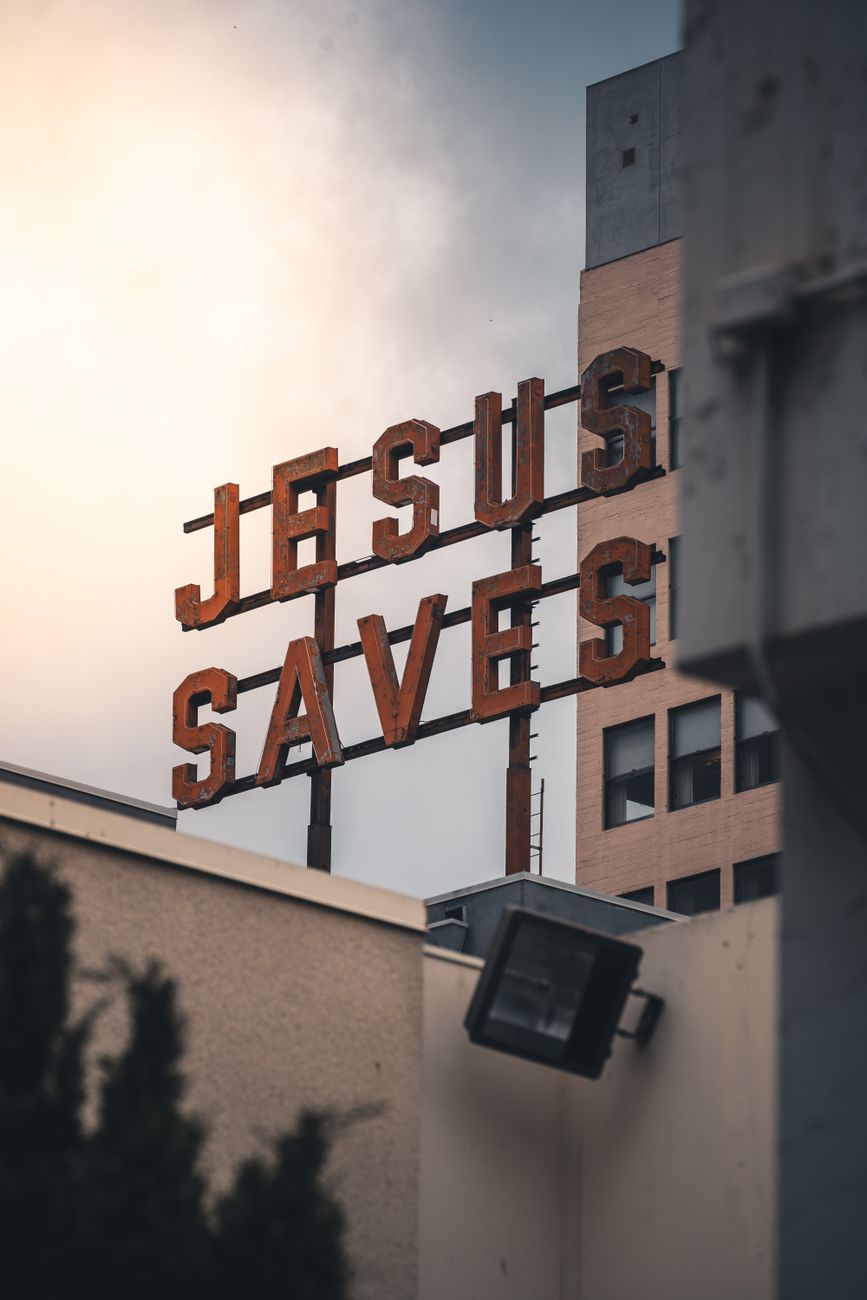
    jesus saves sign in downtown los angeles california usa
    Photo by Willian Justen de Vasconcellos on Pexels.com

    What Is Salvation?

    For most of my life, salvation was a destination.

    Humanity was headed for hell. Jesus provided the way to heaven. The important thing was to believe the right message before death, or at least before Jesus returned and caught you red-handed.

    I still believe in salvation.

    Salvation is healing from everything that distorts the image of God within us. It is freedom from shame, fear, ego, violence, accusation, and the need to dominate. It is awakening to the truth that we already belong to God, then learning to live as though that is true.

    Salvation is not God forgiving us for the terrible mistake of being human.

    It is becoming fully human.

    I once imagined grace somewhere ahead of me. I was broken at the bottom of a hill, while Jesus waited at the top. Faith was the long climb upward.

    But you cannot climb toward the ground already holding you.

    Grace is not the destination.

    Grace is the ground.

    I begin in God. I am held, breathed, and sustained by a Presence I did not create. The problem is not that God is absent, but that I am often asleep, buried beneath fear, religious conditioning, inherited trauma, cultural programming, and the general confusion of being a mammal with Wi-Fi.

    Jesus does not wait at the top of the hill.

    He enters the valley, touches my eyes, and tells me to wake up.

    Salvation is learning to see again.

    It is the false self loosening its grip. It is becoming free enough to forgive, courageous enough to tell the truth, and whole enough to stop needing someone beneath us in order to feel secure.

    It is resurrection beginning now.

    It is heaven taking root in us until we stop manufacturing hell around us.

    Salvation is not merely where we go after death. It is divine life becoming visible in us before we die.

    golden jesus christ statue
    Photo by Nikolai Lapshin on Pexels.com

    Who Is Christ?

    Jesus is the historical person: a first-century Jewish teacher, healer, prophet, mystic, and revolutionary presence who lived under Roman occupation and was executed by the machinery of empire.

    Christ is larger than a surname attached to Jesus.

    Christ names the eternal divine reality revealed through him: the Word through whom all things come into being, the life in whom creation holds together, and the pattern of self-giving love at the heart of reality.

    I do not believe God is a distant being outside the universe, occasionally reaching into creation to perform supernatural interventions. I understand creation as existing within God, saturated by divine Presence without ever exhausting the mystery of God.

    Everything is in God.

    Nothing exists outside the Source from which existence continually flows. Yet God is not simply another name for the universe. Creation lives within God, but God remains infinitely more than creation.

    Christ, then, is not a divine stranger dropped into a godless world.

    Christ is the divine life already present within creation, made unmistakably visible in Jesus.

    In him, humanity and divinity are not enemies. Spirit does not rescue us from matter. The Word becomes flesh, not to teach us to escape our humanity, but to reveal its capacity to bear divine life.

    Jesus embodies Christ in a particular body, place, and time: under empire, among the poor, at shared tables, in the wilderness, beside the sick, on a Roman cross, and beyond the grave.

    Love gets skin.

    Calling Jesus the Christ means that in him we see both what God is like and what humanity is capable of becoming. His uniqueness does not reduce the rest of us to spectators. It opens a path of participation.

    Jesus does not merely ask us to agree with statements about him.

    He says, “Follow me.”

    To follow Jesus is to participate in the life of Christ: forgiving enemies, surrendering our addictions, telling the truth, serving the vulnerable, resisting domination, welcoming the excluded, and allowing the false self to die before the body does.

    Christ is not merely someone to worship from a safe religious distance.

    Christ is a life to enter.

    A pattern to embody.

    A way of seeing and being shaped by union with God, until the love revealed in Jesus begins to take form in us.

    In this gospel, God is not the problem Jesus solves.

    God is the love Jesus reveals.

    a priest reading bible
    Photo by cottonbro studio on Pexels.com

    Why I Am Not Replacing One Label With Another

    There are forms of Christianity expansive enough to hold much of what I now believe. I am grateful for the Christian mystics, theologians, pastors, and ordinary believers who kept windows open inside the tradition while others were building walls.

    But I am not interested in finding a new label strong enough to replace the certainty I lost. Words such as mystic, universalist, panentheist, or follower of the Way can help describe where I stand, but none of them can contain it.

    I am more interested in participation than possession. I would rather follow Christ than define the exact boundaries of who belongs to him. I would rather be transformed by truth than convince myself I own it.

    The word “Christian” also carries particular weight in the United States. It has become entangled with nationalism, political power, exclusion, anti-LGBTQ theology, institutional protection, and a version of faith often more committed to dominating culture than embodying Christ.

    I know this does not represent every Christian. But these are no longer minor associations, and I cannot pretend the word communicates something simple or harmless.

    I am not distancing myself from Christians because I think I am better than them. I still attend church. I still love people inside the tradition. This is not an angry exit letter or an anti-church campaign.

    I am simply trying to be honest.

    I no longer want to defend doctrines that make us afraid of God or excuse cruelty because it comes wrapped in a Bible verse.

    I don’t want to fit inside Christianity.

    I want to become more like Christ.

    silhouette of father and child at serene lakeside sunset
    Photo by Jan Dvorak on Pexels.com

    A Father’s Faith

    Fatherhood made all of this more urgent.

    It is one thing to inherit a theology. It is another to look at your children and decide what you are willing to place inside their imagination of God.

    I want my children to know Jesus without learning to fear the Father he revealed.

    I want them to encounter scripture without being taught to distrust compassion, science, history, their bodies, or their honest questions. I want them to know reverence without coercion and mystery without manipulation.

    I do not want the foundation of their spiritual lives to be the belief that they were born offensive to God and that someone had to die before God could safely love them.

    I want them to know they are earth filled with divine breath. That God is not far away. That love is stronger than death. I want them to encounter the sacred in prayer and mercy, music and meals, nature and laughter, grief and ordinary life.

    I want to give them a God they do not need to recover from.

    That sentence has become one of the clearest measures of my theology.

    If a religious idea makes them less compassionate, less honest, less alive, or more afraid of the God Jesus called Father, they have permission to question it.

    Even if someone attaches a verse.

    Especially then.

    silhouette in a historic archway
    Photo by Juan Carlos Quispe P on Pexels.com

    The Door Is Open

    So this is me coming clean.

    I cannot honestly call myself a Christian, at least not in the way the word was given to me.

    But I have not left Jesus.

    I still believe Christ reveals the heart of what we call God, resurrection is the shape of reality, and love will have the final word over violence, fear, and death.

    For years, I thought faithfulness meant following the religious map.

    Now I think it means putting the map down and walking the Way.

    This is the soil from which The Way of the Source is beginning to grow.

    It is not another denomination or doctrinal checkpoint, but a path rooted in the life of Jesus, seeking truth and wisdom wherever it bears the fruit of love, and grounded in the divine Presence within all things.

    It is for those who cannot return to the old answers but still feel something holy moving beneath the ruins. For the faithful and doubtful, the wounded and wandering, those who still pray and those who no longer know how.

    This is not an invitation to trade one certainty for another. It is an invitation to become present: to ask better questions, recover wonder, practice compassion, tell the truth about what harmed us, and become the kind of people through whom love can move freely.

    It is an invitation to a table around which we might recognize the divine light in one another.

    I do not know exactly what form this will take. I only know something is taking shape.

    So while I cannot honestly call myself a Christian without explaining what I mean, what I no longer believe, and what I am still becoming… I am still following Jesus.

    Maybe you are too, even if the old words no longer fit, your faith has become more question than answer, or you were told that leaving the system means leaving God.

    The doorway is open.

    See you along the Way.

  • The Gospel of Rain

    Photo by Aleksandar Pasaric on Pexels.com

    It’s been raining here.
    A lot.

    Not the soft, wistful kind of rain that makes you want to stare out a window with a cup of tea and listen to Sigur Ros. We’ve had that too, but this has been the relentless kind. The kind of rain that soaks through boots and schedules and small talk. The kind that doesn’t ask permission before it starts washing things away.

    And yet… I’ve been paying close attention.
    Because something in me has started to wonder if the rain knows what it’s doing.
    I’ve been learning about soil. About herbs and healing and the ancient ways—those old paths that understood the body as part of the Earth, the Earth as part of the divine, and healing as a return to harmony and flow, not just the absence of pain.

    I’ve got garden beds waiting to be filled in the backyard. One will be for fruits and foods, the other for herbs and medicines. I’m making my herbalism dreams a reality. An aloe on the windowsill that was thriving until the repotting and still might make it, if grace holds. Grow bags lined up like little promises to my future self. And in the middle of it all, I’ve been watching how the rain seeps into everything—how it turns the compost, softens the crust, reminds the seeds they’re not forgotten down there.

    But this isn’t just a story about gardening.

    This past week, our friends lost everything in their basement. Three feet of rainwater swallowed their world. We spent the weekend cutting drywall, lifting soaked furniture, tossing years of life into a dumpster while their kids watched from the stairs. There’s a particular kind of silence that fills a house after the flood. And there’s a strange kind of holiness in carrying waterlogged pieces of someone’s story, shoulder to shoulder, soaked to the bone, laughing when you can, crying when you need to.

    I work with water for a living. Storm drains. Pipes. Septic tanks. Systems that most people only think about when they fail. I know firsthand what happens when the flow gets blocked. I know how dangerous it truly gets when what was meant to flow stagnates.

    And I think that’s what this rain has been showing me.

    So this is not a weather report.

    This is a gospel.

    A gospel written in raindrops.
    A gospel for anyone who’s ever felt the ground beneath them has turned to mud.
    A gospel for the overwhelmed, the uprooted, the ones learning to grow again.
    Because the rain isn’t here to ruin us.
    It’s here to bring life.
    It’s here to return us.
    To the soil.
    To each other.
    To something older and deeper and far more alive than the life we built on the surface.

    Welcome to The Gospel of Rain.
    Let it soak in.

    -JD

    We are made of these…things…

    dirt… and water… and breath.

    That’s not poetry. That’s Genesis. That’s biology.

    Rain doesn’t just fall from the clouds. It gives. It baptizes the ordinary. It brings the hidden back to life. And if you truly pay attention you’ll start to notice: the Earth doesn’t just respond to rain. It remembers it in a beautiful way.

    And maybe we do too.

    We as people have forgotten the gospel of the ground. The good news written into roots. The sacred story woven by weeds and worms and wild herbs growing in the cracks. Somewhere along the way, we’ve traded the ancient truth for convenience, plastic packaging, and produce that doesn’t rot because it’s so stripped of life it doesn’t even know how to properly die.

    But the gardens still sing the old song. And if we’re willing to slow down, become aware, and listen, it will teach us how to sing along again.

    Jesus, Soil, and the Mystery of Seeds

    Jesus didn’t build temples. He didn’t establish seminaries. He told stories about soil.

    In Matthew 13, he says the kingdom of heaven is like a mustard seed, small and overlooked but capable of becoming a tree that is a shelter for birds. He says some seeds fall on rocky ground, some on shallow soil, some among thorns, and some on good soil…and the difference isn’t in the seeds. It’s in the readiness of the Earth.

    The soul, like the soil, must be open… soft enough to receive, nourished enough to sustain, deep enough to grow.

    This wasn’t purely metaphor. It was sacred geometry. Divine agriculture. A cosmic parable encoded into every living thing: life comes through death, transformation takes time, and good fruit only comes through rootedness.

    Jesus didn’t say believe these doctrines or memorize these creeds. He said:

    “Consider the lilies…”

    “Look at the birds…”

    “The kingdom is like a seed…”

    He was pointing at the Earth, not away from it.

    Photo by Akil Mazumder on Pexels.com

    Honor Your Father and Mother

    There’s an old commandment, one many of us learned in childhood:

    Honor your father and your mother.

    It’s usually read as a family ethic. But I’m beginning to wonder if it isn’t so much more.

    What if the Father is referring to our Divine Source, the heavenly blueprint in the stars, the radiant Spirit that animates all things…

    And the Mother is the Earth, the womb of form, the soil of becoming, the very dust from which we were made?

    In Hebrew, the word for “earth” is adamah—the root of the name Adam. In the Jewish mystical tradition of Kabbalah, Adam represents not just a man, but humanity as a whole—the cosmic being, both formed from the dust and filled with divine breath.

    To honor the Father and the Mother, then, would be to walk in alignment with where we come from—Spirit and Soil. Breath and Body. Mystery and Matter.

    When we dishonor either; by spiritualizing everything and denying the body, or by commodifying the Earth and forgetting the sacred, we lose our way.

    We lose our very selves.

    Wisdom from the East

    The Taoist tradition teaches us about living in harmony with the natural rhythms of life. The Tao is the Way—the Source from which all things emerge and to which all things return. It flows like water, nourishes like rain, moves like wind through trees and time.

    “The Tao does nothing, yet nothing is left undone.” – Lao Tzu

    In gardening, this wisdom becomes real. You can’t force a plant to grow. You prepare the soil, tend the space, and then you must trust the seed to know what to do. This is the heart of both mystical faith and herbal practice: alignment and harmony, not control.

    In Hinduism, the idea of dharma reflects your truest path—your alignment with nature, spirit, and self. There’s a beautiful teaching that all beings have their own dharma, even a leaf or a river. To live your dharma is to live like a tree: rooted, patient, in service to the whole.

    Herbalism becomes dharma when we begin to see each plant as a bearer of wisdom, each root as a teacher. We don’t just utilize them—we commune with them and we learn from them.

    Photo by Pixabay on Pexels.com

    Soil as Scripture, Rain as Revelation

    We were made from the dust. That’s not a demotion. Honestly, it’s a deep honor. The same elements that form stars form your cells. The same carbon in a fallen tree lives on in your bones. The Earth isn’t beneath us. She is of us.

    The Bible says, “The heavens declare the glory of God, the skies proclaim the work of his hands” (Psalm 19:1).

    And the Earth?
    She doesn’t just absorb the rain
    She listens. She remembers. She responds.

    Rain isn’t just water falling from the sky.
    It’s the memory of the heavens returning to the soil.
    It’s the baptism that makes resurrection possible.

    Soil isn’t just dirt.
    It’s alive. Teeming. Holy.
    A thin place where death becomes nourishment.

    And the herbs we plant?
    They’re not just medicine.
    They’re messengers.
    Whispers from the old world,
    carrying healing that’s older than any of the systems we’ve created.

    The Garden is Calling Us Back

    We live in a time when disconnection is profitable.
    But reconnection is powerful.
    Revolutionary.
    Healing.

    When you grow your own food, you remember that abundance isn’t just an idea, it’s a practice.

    When you tend to your herbs, you remember that healing is not always instant.
    It’s relational.

    When you let the rain baptize your garden, you remember that nothing living thrives without receiving.

    This is the gospel of the garden.

    The truth that’s been growing since the beginning.

    Eden is not lost, it’s waiting for us to honor our Father and our Mother.

    Since you’re still here, I wanna know:

    What are you growing this season in the soil?
    In your body?
    In your spirit?

    What rhythms are you aligning with that the world told you to ignore?

    What would it look like to honor both your Father in heaven and your Mother beneath your feet?

  • Lost in Translation: How Etymology Woke Me Up

    It started with… a sandwich.

    Not a metaphorical one — an actual turkey-and-cheese situation I threw together on a rushed lunch break. For some reason, I wondered why we call it a “sandwich” in the first place.

    Wasn’t Sandwich a place? Or an Island?

    A quick google search later, I’m staring at the ridiculous story of John Montagu, the 4th Earl of Sandwich, too busy gambling to step away for dinner, so he ordered meat stuffed between bread. And now, centuries later, here I am — not a nobleman or aristocrat, just a guy eating his Earl-named lunch.

    It was just kinda funny at first, but then the chord struck: this completely normal, everyday word carried a whole story inside of it — a story that almost nobody knows. This study of the origin and evolution of words, I found, was called etymology.

    So I kept going. I started studying the etymology of even more words. And that’s when things got weird.


    The Rabbit Hole Begins

    Take “clue,” for example.

    I always thought a clue was just… well, a hint. Something Sherlock Holmes sniffs out. But the word traces back to “klew,” meaning a ball of yarn — like the one from the Greek myth of Theseus. He didn’t solve the labyrinth with a sword or brute force; he found his way out by unwinding a ball of thread, or klew, to retrace his steps.

    A clue wasn’t originally about solving something — it was about finding the way home.

    Then there’s “sincere.” We use it to mean genuine or honest, but its roots go back to Latin: “sine cera” — meaning “without wax.” Back then, sculptors would use wax to cover flaws or cracks in their work. A statue that was truly flawless didn’t need the cover-up. It was sine cera — pure, unhidden, whole.

    How wild is that? Sincerity, at its core, isn’t just honesty — it’s wholeness without the cover-up.


    Words That Hold More Than We Realize

    The more I dug, the more I realized how many words hide deeper, almost poetic truths.

    “Disaster” — from the Greek “dis” (bad) and “aster” (star). It literally means “bad star,” a misfortune caused by the heavens.

    “Companion” — from Latin “com” (with) and “panis” (bread). A companion isn’t just a friend — it’s someone you break bread with.

    “Ecstasy” — from Greek “ekstasis,” meaning “to stand outside oneself.” It’s not just joy — it’s a moment so powerful it pulls you out of your own being into a state of bliss.

    And then I stumbled on something bigger — words that didn’t just hold history, but felt like they were pointing to something about humanity itself.


    Breathing in the Divine

    Let’s talk about “inspire.”

    It’s a word we hear all the time — motivational speakers throw it around like confetti. But the root meaning knocked me sideways.

    “Inspire” comes from the Latin “inspirare,” which literally means “to breathe into.” It wasn’t about feeling motivated to write a book or start a project — it meant being filled with breath, with life itself.

    It’s the same word used to describe how God breathes life into “Adam” in the Genesis story — the very breath of existence. I’ll dive in to the etymology of Adam and Eve another time…

    Inspiration wasn’t about productivity. It was about being alive.

    Desire, Fire, and Stars

    Then I found “desire.”

    It’s another word we think we understand — wanting something, longing for it. But its origin is so much more than that.

    “Desire” comes from “de” (from) and “sidera” (stars). It’s origins literally mean “from the stars.”

    Desire wasn’t about craving or lust. It was about yearning for something beyond this world — a pull toward the heavens.

    And the more I sat with that, the more I couldn’t ignore the pattern:

    • Disaster — a bad star.

    • Desire — a longing from the stars.

    • Inspiration — the breath of life itself.

    • Ecstasy — to step outside yourself.

    It’s like these words were trying to remind us of something — that we’re not meant to be stuck down here in the dirt, chasing power, money, cars, impressive titles, or just surviving. We’re meant to breathe deeply, reach for the stars, and step outside ourselves.


    The Awakening Beneath the Words

    Somewhere in this journey, it stopped feeling like I was learning trivia. It felt more like I was waking up to something ancient — something we used to know but forgot along the way.

    Words are time capsules. They carry not just definitions, but stories, beliefs, and truths that our ancestors lived and breathed. And those truths still pulse beneath the surface, waiting for us to notice them.

    We didn’t invent language to make small talk. We invented it to name the things that stir our souls.

    We long for the stars — desire.

    We’re filled with life — inspire.

    We ache to step outside ourselves — ecstasy.

    And even our disasters are written in the heavens — stars.

    Language, it turns out, isn’t just about communication. It’s a mirror — one that reflects back who we’ve always been: creatures caught between earth and sky, longing for more.

    I’m not sure if words saved my soul, but they sure as hell woke it up.

    And to think… all of this beauty and wonder and history started with… a sandwich.

  • Embracing Doubt: A Journey Through Faith Deconstruction

    A quick note: I’m currently writing a book. It’s going to be a spiritual autobiography that will include much of what’s in this post, and much of what’s already been posted on this blog, but will go into much greater depth. The topic of deconstruction alone has inspired entire blogs and books of their own. So with that being said, here’s a glimpse into my journey through deconstruction.

    -JD Merrill

    I remember the first time I felt the floor cracking beneath my faith.

    It wasn’t a slow erosion… it was an earthquake. A single question at first, then another, then a tidal wave of doubt that left me gasping for air. Things that had once felt rock-solid… God’s goodness, the reliability of scripture, the purpose behind it all… suddenly seemed fragile, even hollow.

    And the worst part?

    I had been taught that doubt was the enemy.

    In the faith tradition I grew up in, questioning wasn’t just discouraged: it was dangerous. It meant you were “backsliding,” being “led astray,” giving in to the deception of the world. There was a formula: Believe. Obey. Don’t ask too many questions. If the answers didn’t make sense, the problem was with you, not the system. So when my questions became louder than the sermons, when my prayers felt like they were evaporating into silence, I was left with an unbearable weight of guilt.

    Maybe you know the feeling.

    Maybe you’ve sat in a church service, surrounded by people singing with a sense of certainty, while something inside you whispered, I don’t know if I believe this anymore. Maybe you’ve tried to ignore the nagging contradictions, hoping that if you just had more faith, the doubts would go away. Maybe you’ve been told that your questions mean that you’re losing your faith. But what if that’s not true? What if deconstruction isn’t falling away, but waking up?

    When the House Falls Down

    For a long time, I saw faith like a house. A sturdy, well-built structure I had inherited, passed down from generations before me. It had walls made of doctrines, floors of biblical inerrancy, a roof of absolute certainty. It kept me safe. It kept everything in order. But when the cracks started forming, when I realized some of those walls weren’t as solid as I had been told, the whole thing started shaking. And when it finally collapsed, I thought I had lost everything. I felt like I had lost a God who had been my best friend for my entire life.

    For me, deconstruction started in the background, on the periphery, like a creeping vine I wasn’t paying too much attention to. When something didn’t make sense to me, I could just set that aside until I had better understanding or a new perspective. I had always been one to challenge tradition and the status quo. I was raised charismatic, after all, so if something didn’t resonate with my spirit, I needed to know why. Why do we do things this way instead of that way? If I understood the “why” I could either get on board, or find a new avenue.

    After leaving the church we met at, my wife and I were part of planting a new church. As the Worship Leader I had the opportunity to decide what kind of songs and what kind of theology we were going to incorporate through music. So I started really paying attention to the lyrics of every song, to see if they resonated with what we believed, and what this new church was going to believe.

    Bring On The Questions

    It wasn’t the big doctrines that wavered at first—it was what I would consider secondary beliefs:

    Was Noah’s Ark historical?

    Was Jonah really swallowed by a great fish and survived?

    Was Jesus actually born of a virgin?

    Was the Earth created in 6 business days?

    Were these stories meant to be taken literally, or was there something deeper I was missing?

    As time went on, however, the questions grew bolder. The cracks spread. Pretty much everything except the person of Jesus stopped making sense to me… or at least, it didn’t make sense in the way I had always understood it.

    And all the while, I was still leading worship. Still married to a Christian woman that I met at church. Still getting my paycheck from the church. It wasn’t just my faith that was unraveling. It was my entire identity. My career. My way of life. Worship leading wasn’t just my job; it was who I was. It was the thing I had always wanted to do, the dream I had carried since I was a kid.

    And then, one night, while studying the Bible and examining the lyrics to a song, the last brick in the foundation of my faith crumbled.

    And I still had to lead worship practice.

    I had to pray out loud to lead a worship team that I was building, who were looking to me to lead them, knowing I no longer believed in a God who was out there somewhere listening. I had to lift my hands in the songs I had led a thousand times before, knowing they no longer meant the same thing to me. I had to stand in a room full of people who had no idea that, inside, I felt like I was disappearing.

    The Dark Night of the Soul

    This journey through doubt and uncertainty is not a new phenomenon. In the 16th century, St. John of the Cross wrote about the Dark Night of the Soul, describing it as a period of spiritual desolation, disorientation, and doubt that precedes a deeper communion with the Divine. He wrote:

    “To come to the knowledge you have not, You must go by a way in which you know not.” —St. John of the Cross

    Contemporary theologian Peter Rollins echoes this sentiment, suggesting that embracing doubt is integral to authentic faith. He says it this way:

    “The point is only that the believer should not repress the shadow of doubt that hangs over all belief… Instead, the believer ought to acknowledge and even celebrate this dark night of the soul, understanding that this is not a threatening darkness which conceals an enemy but rather is the intimate darkness within which we embrace our faith.” —Peter Rollins

    Deconstruction as an Invitation

    For so many of us, deconstruction starts with grief. The loss of certainty, the unraveling of everything we thought we knew. But what if it’s not just an ending?

    What if it’s an invitation?

    To see the Divine… not in rigid doctrines, but in the uncontainable vastness of reality itself. To find meaning… not in having all the answers, but in the beauty of the mystery. To encounter “God”… not in the places we were told they must be, but in the places we never expected.

    For me, the breaking of my faith wasn’t the end. It was the beginning of something deeper, something freer. I stopped looking for God in the confines of a religious system and started experiencing the sacred in the very fabric of existence. In music that shook me to my core. In the stillness of the morning. In the unfiltered, unforced moments of love and connection that needed no theological justification to be real. And here’s the paradox: It wasn’t until I let go of certainty that I actually found something worth holding onto.

    Losing to Find

    Jesus once said, “Whoever loses their life for my sake will find it.” I think that can apply to our faith, too. Maybe the faith we were handed… the kind that demands certainty, that requires obedience without question, that fears doubt like a disease… was never the point. For me it was just scaffolding, a temporary structure meant to get us to a place where we could finally encounter something real. The loss of that faith doesn’t have to be just a tragedy. Maybe it’s the first breath of freedom.

    What Next?

    If you’re in that space of the in-between, the aftermath, the uncertainty I want to tell you something I wish someone had told me:

    You are not broken.

    You are not wrong.

    You are not failing.

    You are not alone.

    But… please keep an open mind.

    I didn’t mean to stop believing in God. It wasn’t a choice I made, a rebellion I embraced, or a philosophy I eagerly adopted. It was more like a slow, unrelenting erosion… like the tide pulling the sand from beneath my feet until I realized there was nothing left to stand on.

    At first, there was grief. Crying in my car outside of a church because I couldn’t’t take communion. That was for believers, and for the first time I was on the outside of that. But over a few weeks that led to a sense of relief. The weight of trying to reconcile an ancient faith with the brutal realities of the modern world had been exhausting. Without God, I was free. Free from the cognitive dissonance, the theological gymnastics, the need to justify suffering with some twisted divine purpose. Free to love and accept everyone, no matter their religion, sexual orientation, voting record, or any of the other ways we divide ourselves.

    There was something clean about it, something sharp. The world made sense in a way it never had before… random, indifferent, ruled by chaos and natural laws rather than magical celestial orders. And for a while, that was enough. I leaned into thinkers like Dawkins, Hitchens, and Harris, reveling in their unflinching logic. I found comfort in the idea that morality was an evolutionary construct, not a divine mandate. The universe didn’t care, and maybe that was okay.

    But atheism, like the faith I had left, held its own brand of certainty and exclusivity. I saw it in online debates, in the way ex-believers scoffed at spirituality, dismissing anything beyond the material as childish wishful thinking. And if I was honest with myself, I had adopted that same posture. I had traded one dogma for another, one absolute for a different kind. I became cynical. There was no room for mystery, no space for wonder. The vastness of existence had been reduced to atoms and neurons, cause and effect. And yet, something in me still ached.

    It was in that emptiness that I found something unexpected. Or rather, something found me. Because even when I had deconstructed everything, even when I had tried to empty myself of God, there was still… something.

    Not the old man in the sky. Not the tribal deity of my childhood. But a presence, a current, a whisper beneath all things. It wasn’t a return to certainty, it was a surrender to unknowing. And in that surrender, I began to heal. I embraced experience, and found hope in adopting a mystical lens.

    Deconstruction is not the end. It is the beginning. The bravest thing you can do is walk into the dark, not knowing if the ground will hold, trusting that even in the void, you are not alone. Because once you have a real question, there is no way out, only a way through.

    As St. John of the Cross once wrote, “If a man wishes to be sure of the road he treads on, he must close his eyes and walk in the dark.”

    So for today, don’t be afraid of doubts.  Don’t be afraid of questions. Your community may not understand, and there may be very real risks in being authentic and striving for truth. But if you stay curious, brave the uncertainty, and refuse to accept hollow answers, you will find truth. What is true will remain true regardless of your questioning. And any “God” worth believing in, will be there on the other side in a way that’s more true than you ever thought possible. And when new questions or doubts arise, you will have the tools and experience needed to navigate the mystery with intellectual integrity and joy.

    And hopefully, like me, you’ll find that in the ancient wisdom traditions lies a truth that is so deep, so true, and so real that you have to use metaphor, allegory, and poetic language. Because once you pin down the butterfly to examine its wings, it loses its ability to fly.

    Stay curious, my friends. The truth runs in the deep streams.

  • “Hallelujah!”

    The Wild Unstoppable Cry of the Soul

    Growing up in a charismatic Pentecostal church and family, I heard the word Hallelujah a lot. Sure, it was shouted during sermons, whispered fervently in prayer, and sung with hands raised high. Usually, it was said as a trivial celebration when my mom found her keys or that thing she’d been looking for for weeks. I often hear it used sarcastically. When I was touring with Settle The Sky, my Christian metal band, Hallelujah was screamed into microphones, echoing through sweaty clubs and church basements, sometimes from the voices of kids who weren’t even sure what they believed—but something about that word felt powerful. And while everyone used this word, I felt like most people didn’t seem to be able to articulate what it really meant.

    Hallelujah isn’t just a word. It’s a cry. A defiant, unrelenting, soul-shaking exclamation that transcends language, genre, and even belief systems. It’s one of the few Hebrew words that has made its way, unchanged, into nearly every language on earth. My wife, Ariel, walked down the aisle to an acoustic version of this song whose only lyric was just the word Hallelujah.

    But what does Hallelujah actually mean? And why does it hold so much weight—whether whispered in worship, shouted in ecstatic praise, or screamed over a hardcore caveman riff in a Sleeping Giant song?

    The Etymology of Hallelujah:

    The word Hallelujah (הַלְלוּיָהּ) is made up of two parts:

    • Hallelu (הַלְלוּ) – A command meaning “praise” (from halal, meaning to shine, boast, or act wildly celebratory).

    • Yah (יָהּ) – A shortened form of YHWH, the divine name of God.

    So Hallelujah literally means “Praise God!” But not in a quiet, reserved, or passive way.

    The root word halal is wild. It comes from the exclamation of freedom. In Islam, if a food is “halal”, then it is praised by the divine and they are “free” to eat it. It means to boast, to rave, to shine, to act clamorously foolish in celebration. It’s the kind of word that doesn’t fit neatly into the stoic, buttoned-up version of faith so many of us were handed. Halal is loud. It’s undignified. It’s messy.

    It’s the kind of word that makes most religious people uncomfortable.

    Dance Dance Revolution

    One of the most unrestrained biblical pictures of true Hallelujah comes from 2 Samuel. King David, who was a warrior and poet, brings the Ark of the Covenant back to Jerusalem. And how does he celebrate?

    He dances.

    Furiously.

    He strips off his royal linen robes and dances before the Lord with all his might, completely unbothered by how ridiculous he looks. His wife, Michal, watches in disgust, embarrassed by his lack of dignity. That’s a striking image for Michal’s attitude toward David. She wasn’t just upset; she was cutting him off in her heart, separating herself from his joy and his deep, intimate worship before Yahweh. But David doesn’t care.

    “I will become even more undignified than this!” he tells her. “I will be humiliated in my own eyes!” -2 Samuel 6:22

    That is Hallelujah—the kind of unrestrained, all-consuming celebration that doesn’t care about appearances or what kind of societal consequences or judgment it brings up in others. The kind that doesn’t hold back. The kind that shakes the ground.

    Hallelujah in Metal, Hardcore, and Charismatic Worship

    When I look back, I realize that my time in the charismatic church and my time in metal and hardcore were deeply connected by this same reckless, passionate spirit.

    In charismatic churches, worship wasn’t just singing songs… it was warfare. It was an outpouring of emotion. People danced, shouted, wept, fell to their knees. Some spoke in tongues. Some shook under the weight of something they couldn’t explain. The band played loud, but not for performance or recognition, but because the Spirit was moving, and nothing about that moment should be tame.

    Then I stepped into the world of metal and alternative music, and I felt something eerily familiar. The intensity. The passion. The catharsis of screaming from the depths of your soul, of pushing your body to the limit, of letting go of self-consciousness and giving everything you have to something bigger than yourself. To the energy that was stirring up between everyone in the room.

    In the pit at a hardcore show, I saw people swinging fists, jumping off stages, pile-driving toward a moment that felt transcendent. When we played, I saw kids who wouldn’t set foot in a church scream their lungs out to lyrics about redemption, about sacrifice, about love, about hope. The church might not have understood our art form, but it was never really about playing music or getting fame or being a rock star. It was about uniting the broken in a moment of raw transcendence.

    To me, that is Hallelujah.

    Hallelujah and the Illusion of Separation

    There’s something about raw, undignified presence and unity that breaks through the illusion that we are separate from something greater. Not the polished, performance-driven kind that is trying to impress to satisfy an egoic need—but the kind that throws off every weight, every inhibition, and lets the soul truly cry out.

    Hallelujah is not about conformity. It’s about connection. It’s about that deep, undeniable pull that every mystic, every artist, every seeker has felt—the pull toward something vast, luminous, and overwhelmingly real. Whether you call it God, the Tao, the Divine, the Source, the Universe, or simply Love, there is something in all of us that knows:

    There is more.

    And we are all a part of it. We are all invited to leave our egos at the door so our truest self can be free.

    Hallelujah is the moment the wave crashes and you feel one with the ocean.

    It’s the lump in your throat when a song wrecks you in the best way.

    It’s the dancer lost in flow state movement, the poet captivated in words, the mother holding her child, the breath that catches in awe.

    It’s in the scream of a metalhead in the pit, in the whispered prayer of the doubter, in the sigh of the atheist staring up at the stars, feeling something too beautiful for words.

    Hallelujah isn’t just for “believers”. It isn’t just for “church”. It isn’t just for those who understand. It’s for whoever breathes.

    Psalm 150:6 – Let everything that has breath praise Yah.

    And Yah means YHWH

    The Invitation to Live Hallelujah

    Maybe you’ve been taught that spiritual connection had to look a certain way—had to fit into a religious mold that never quite felt right. Maybe, like me, you felt more of something divine in the roar of a crowd than in a pew. Maybe you were outcast by a church more focused on everyone believing and behaving the same way than having a real encounter with an untamed spirit. Maybe you’ve been waiting for permission to show up fully as you are, to throw off self-consciousness, to stop filtering your presence and just be—raw, honest, unrestrained.

    Here it is.

    Let your Hallelujah be loud. Let it be messy. Let it be real.

    Not because you have to worship a deity, or a god out there somewhere else, not because you need to fit into any system of belief, or any organized religion.

    But simply because you are alive.

    Because you are part of something bigger than yourself. Because your voice, your body, your breath, your existence—it all matters.

    Because to be fully alive, fully present, fully surrendered to this eternal moment—that is the cry of Hallelujah.

  • The God Without a Name

    Finding the Divine in the Breath of Life

    Zeus. Buddha. Shiva. Ra. Flying Spaghetti Monster.

    Have you ever wondered why most deities have names—but the Christian God is most often just called “God”? This used to baffle me as a kid. I remember thinking that other religions must think we’re so arrogant. We didn’t just claim our God was the one true God—we took the very word “God” and used it as His name.

    Names have power. They define, they distinguish, they shape how we understand something. Yet, in the Western World where it’s almost assumed that everyone is a Christian, the Divine is often left with a generic title rather than a personal name. Why?

    The answer to this mystery lies at the source. It is ancient and profound—something that has been hidden in plain sight within the earliest writings of the Bible itself.

    YHWH: The Breath of Existence

    The first time we encounter the Divine Name in the Hebrew Scriptures is in the story of Moses and the burning bush from the book of Exodus. Moses, a shepherd and fugitive, finds himself drawn to a strange sight—a bush engulfed in flames that is never consumed by the fire. As he approaches, he hears a voice calling his name. This is no ordinary moment; it is an encounter with the Divine.

    Moses asks the voice, “Who should I say sent me?”

    And the response is enigmatic, profound: Ehyeh asher Ehyeh (אֶהְיֶה אֲשֶׁר אֶהְיֶה)—or in English “I AM that I AM.” It is an answer that refuses definition, evading labels and fixed identities. Then, God gives Moses the Name: YHWH.

    This moment is mystical, deep, and powerful. The name revealed is not just a title but a verb, a state of being. I AM. It is existence itself, the ever-present, ever-unfolding Source. YHWH is not a static deity bound to a temple or an image but the very essence of life itself. The Israelites would come to see this name as so sacred that they wouldn’t use it in writing or speaking, because it is a mystery that could only be experienced but couldn’t be fully grasped or nailed down.

    Most scholars believe that it should be understood as a symbolic representation of God’s presence and call to Moses, rather than a completely literal account of a physical burning bush that did not burn up. The focus is on the divine encounter and the message conveyed, not necessarily the exact details of the imagery or its literal nature. Keep in mind that this writing is premodern and doing its best to give language and story to the mystery that we call the Divine.

    The Hebrew Bible does not originally call the Divine simply “God.” It speaks of YHWH (יהוה), a name so sacred that it was often left unspoken. But this isn’t just about reverence—it’s about something deeper.

    Some scholars and mystics suggest that YHWH is not a typical name at all, but an attempt to capture the sound of breathing. Say it slowly without vowels—YH…WH…—and you might notice how it mirrors the rhythm of inhaling and exhaling. In this sense, the Divine name is not meant to be spoken in the traditional sense, but experienced. Every breath we take is a reminder of the Source, the ever-present reality sustaining all life.

    I remember the first time I heard this idea, and it hit me like a punch to the gut. The name of the Divine—so ineffable, so untouchable—was something I had been unconsciously uttering my entire life. With every inhale and exhale, I had been speaking the Name. It wasn’t something separate from me; it was within me. It was me, and it was you, and it was everything that has breath. What animates us all.

    Why Was YHWH Left Unspoken?

    In Jewish tradition, YHWH is considered too sacred to pronounce. Instead, substitutes like Adonai (meaning “Lord”) or HaShem (meaning “The Name”) are used. But even these alternatives hint at something beyond language itself.

    Adonai, meaning “Lord” or “Master”—and also, incidentally, a banger of a song by Petra—comes from a root meaning “sovereign,” a term of reverence, yet it does not replace the unspeakable reality of YHWH—it only gestures toward it. The reluctance to speak the Name serves as a reminder that the Divine is beyond human categories, beyond definition, beyond limitation. The moment you try to define it, you lose it.

    This stands in stark contrast to modern Christianity’s casual use of the term “God.” It’s a catch-all phrase that has become so generic that it often loses its depth and mystery. Yet, the ancient understanding suggests something radically different: the Divine is not a concept to be named, but a presence to be encountered. A spirit to be present with.

    Echoes in Other Traditions

    This idea—that the Divine is beyond naming yet intimately present and accessible—resonates across spiritual traditions.

    • In Taoism, the Tao Te Ching begins with: “The Tao that can be spoken is not the eternal Tao.” Like YHWH, the Tao is beyond words, a force that underlies all existence. Tao actually means “The Way,” which I find quite fascinating.
    • Hinduism speaks of Brahman, the supreme universal spirit, the ultimate reality that cannot be fully defined, yet is the essence of all things. The sacred sound Om is often said to contain the vibration of all existence, much like YHWH as breath.
    • Sufism, the mystical branch of Islam, often chants the Divine name Hu in meditation. Hu is the breath of life, the ungraspable presence of Allah, known not through intellect, but through experience.

    Reclaiming the Sacred Mystery

    So what happens when we move beyond “God” as a mere label and return to the mystery to be experienced? What if we stopped trying to define the Divine with rigid words and instead sought it in the breath, in the motion, in the silence, and in the spaces between?

    I think about my friends who have walked away from religion, many of them artists, musicians, and punks who reject anything that smells like control or dogma. I get it. I’m there too. Especially with the current state of the church in America. But what if the problem isn’t the Divine itself, but the way it’s been packaged and sold? What if the real thing was never meant to be locked inside churches and creeds, but was as close as your next breath?

    To speak the Name of God is to breathe. To seek the Name of God is to live life to its fullest and most abundant.

    In the words of Father Richard Rohr: “I remind people that there is no Islamic, Christian, or Jewish way of breathing… The playing field is utterly leveled.” No one and no religion can control this spirit.

    This shatters identity politics and the idea that the Divine is exclusive to any certain people group. If you breathe, you’re in. Period.

    The Name that isn’t a Name is still speaking.

    Are you listening?

  • You never knew THIS about Valentine’s Day

    Is it just me or have Valentine’s Day products been on the shelves since like Christmas Eve? Let’s not even get started on the corporate consumerism of it all, because while true, that sounds draining and stressful. I want to talk little bit about real love. I’m sure all the retailers and date night spots would like you to believe that love is something you can buy.  Or at the very least, that you have to spend money to prove your love adequately. But we all know that love is one of those things that can’t be bought. Love can’t be defined. Love can never fully be expressed or contained. Artists, poets, philosophers, filmmakers and humans throughout all of history have tried to capture something that seems to be futile to the ineffability and infinity of love. Behind the candles, dessert menus, and manufactured romance this week lies an invitation to explore an eternal mystery:

    What is love?

    Like, really….what is it? And how do we begin to grasp its infinite depth?

    A Brief History of Valentine’s Day

    The origins of Valentine’s Day are hazy, and a bit jumbled together from history, legend, and myth. The most famous tale tells of St. Valentine, a priest in 3rd-century Rome. Emperor Claudius II had placed a ban on marriage for young soldiers. Our boy Valentine risking everything, he performed secret weddings, believing that love transcended law, empire, and even death. For this, he was put to death on February 14th, and his legacy grew into a celebration of love.

    But long before St. Valentine, around the same date in February was Lupercalia. Lupercalia was an ancient Roman festival of fertility, passion, and renewal. It was a time when love was understood as something untamed and primal, honestly maybe even a bit brutal at times. They saw love as a force woven into the very fabric of existence.

    From the earliest days of human history, love never seems to be merely sentimental or easy to capture with words.

    Love is…  Sacred.

    Esoteric.

    Transformative.

    It is the fire that has bound hearts, shattered oppression, and opened doorways to the divine throughout eternity.

    Ancient Wisdom on Love

    Traditions across the world have long understood love as more than an emotion and more than human attachment or pair bonding. Love is the gravitational force of our souls, the spiritual thread stitching all things together, the current that carries us back home.

    • The Taoist Perspective: Love is the dance of Yin and Yang, the interplay of opposites. It is not about possession or control but balance. Allowing the other to be fully themselves while remaining fully yourself. Love is not static. Love is found in the flow, in surrendering to the harmony of existence.

    • Hindu Teachings: The Bhagavad Gita speaks of bhakti, a love that transcends the physical and becomes devotion to the divine in all things. To love another fully is to see God within them, to recognize that every face is a reflection of the infinite. Namaste.

    • Jewish Mysticism (Kabbalah): In Kabbalah, love (ahavah) is not just an emotion but an act of giving, a channel through which divine energy flows. The more we give of ourselves, the more we reflect the divine essence that permeates all things. Love expands the soul, dissolving the illusion of separateness from God.

    Jesus and the Way of Love

    Jesus did not just teach love; he embodied it. And not the pretty pink love of overpriced greeting cards, but a love so radical, so boundary-shattering, that it turned the world upside down.

    • “Love your neighbor as yourself.” This is not just an ethical rule, it is a deeper truth about our connection to one another. The boundaries we perceive between our selves, “me” and “them”,  are not as solid as they seem. When we love another, we reflect that love within ourselves. When we harm another, we diminish something within our own soul.

    • “Love your enemies.” Jesus knew that love isn’t about being deserving. It isn’t earned. It is not a transaction. Love simply is. A force that flows freely, without condition, because love is the very nature of God. And aligning ourselves with that spirit, living in this way can heal ourselves and those around us. 

    • “Greater love has no one than this: to lay down one’s life for one’s friends.” I truly don’t think that this is merely about physical sacrifice, but about something far deeper: the surrender of the self we construct, the one bound by ego and illusion. The one that sees itself as separate. To love is to release that false self and step into the greater reality of connection. It is letting go of the masks we wear, the pride that separates us, and the fear that keeps us from recognizing the deep river that flows through us all. 

    Love as the Bridge to the Divine

    Love is not something we possess. It possesses us. It moves through us like breath, like light, like the pulse of the universe itself.

    To love deeply is to see beyond the illusion of separateness. To love fully is to recognize the divine in every face, in every moment, in every breath. Love is not a reward. It is not a prize to be won. It is not earned. Love simply is. It is the essence from which we come and to which we return.

    An Invitation to Love More Fully

    This Valentine’s Day, go beyond the surface-level expressions of love. I’m hoping that we expand our love beyond romance to the stranger, to the enemy, to the earth itself. To love with the reckless abandon of mystics, the unwavering devotion of sages, and the boundless generosity of the Source from which all love flows.

    Whisper a blessing to someone in silence. Speak love into the world, even to those who may not return it. Reject fear. Love your enemies. See the divine in the ordinary… in the eyes of a friend, in the face of a stranger, in the reflection staring back at you in the mirror.

    Let love not be a fleeting feeling, but the very path that leads us home.

    Because in the end, love is not something we give or receive.

    Love is who we are.

    Love is who I Am.

  • Teshuvah: Repent or Return?

    If you grew up in church, you probably heard the word repentance a lot. Maybe it was shouted from a pulpit, written on a sign, or used in altar calls:

    “Repent, or burn in hell!”

    “Repent and be saved!”

    “If you died tonight, would you go to heaven or hell?”

    For many of us, repentance meant fear—a desperate attempt to stay on God’s good side. It wasn’t about transformation; it was about avoiding punishment.

    Repentance was something we did when we felt guilty, when we messed up, when we knew we weren’t enough. It was tied to shame—the deep, gut-wrenching feeling that not only had we done something wrong, but that we were wrong.

    How many times did we sob at the altar, begging God to forgive us, only to walk away feeling like we were never quite clean enough? How often did we promise to be better, to stop sinning, to try harder—only to fail again and spiral into self-hatred?

    And the worst part? The cycle never ended. Guilt. Shame. Fear. Try harder. Fail. Repeat. I must’ve been “saved” at that youth group altar at least a hundred times and still it never felt like it “stuck”.

    This was “repentance” as we understood it—a painful, never-ending struggle to make ourselves acceptable to God so he wouldn’t send us to hell.

    But what if I told you that this isn’t at all what repentance was meant to be? That the original Hebrew concept of Teshuvah is something radically different—something healing, something freeing?

    Teshuvah: More Than Just Saying ‘Sorry’

    The word Teshuvah (תשובה) is usually translated as “repentance,” but that translation barely scratches the surface. Teshuvah comes from the root shuv (שוב), which means to return.

    It’s not about groveling before an angry God. It’s not about wallowing in guilt. It’s about coming back home.

    Teshuvah is the realization that you were never meant to be lost. That even when you wander, the way back is always open. That you are not a filthy sinner begging for mercy—you are a beloved child, made in the image of the divine, finding your way back to wholeness.

    Breaking the Cycle of Shame

    One of the most damaging things about our modern idea of repentance is that it keeps us trapped in shame. Shame isolates. Shame paralyzes. Shame tells us we’re broken beyond repair.

    But Teshuvah offers something entirely different: healing.

    Instead of saying, “You are a failure, and you must pay for your mistakes,” Teshuvah says,

    “You have lost your way, but you are not lost forever. Come home.”

    Instead of saying, “You are defined by your worst choices,” Teshuvah says,

    “Your past is not your identity. Who you truly are is deeper, truer, and has always been connected to the divine.”

    Instead of saying, “You must earn forgiveness,” Teshuvah says,

    “You are already loved. The path to healing is open—step into it.”

    Teshuvah as a Path to Transformation

    Teshuvah isn’t a one-time event. It’s not just about asking for forgiveness. It’s a lifelong rhythm of waking up, realigning, and returning to who you were created to be.

    Jewish wisdom teaches that Teshuvah has four essential steps:

    1. Recognizing the misalignment – Honestly acknowledging where you’ve gone off track. And that’s all it is. Stepping off of the path.

    2. Feeling true remorse – Not guilt, but a deep realization of what has been lost.

    3. Making amends – Repairing what has been broken, especially in your relationships, actions, or intentions. My AA friends know all about this step and how crucial it is.

    4. Committing to change – Becoming someone who, given the same situation, would choose differently. Not about doing anything, but about who you are, what you believe about yourself, and what you believe about the world around you.

    And here’s the most radical part—Teshuvah doesn’t just erase your mistakes. It transforms them.

    In Jewish thought, when Teshuvah is done from a place of deep love and sincerity, even past sins can become merits. The very things that led you away can become the very things that bring you closer to the divine. Your story isn’t ruined—it’s redeemed.

    Teshuvah and the Teachings of Jesus

    Jesus, as a Jewish teacher, absolutely understood Teshuvah. When he spoke about “repentance” in Greek (metanoia), he was talking about a fundamental shift in perception—a transformation of consciousness. He wasn’t calling people to wallow in guilt, but to awaken to something greater.

    Think about the parable of the Prodigal Son (Luke 15). The son leaves home, squanders everything, and finally realizes he needs to return. He expects shame and punishment—but instead, his father runs to embrace him. That’s Teshuvah.

    Jesus wasn’t preaching fear-based repentance. He was showing us The Way home.

    Living a Life of Teshuvah

    So what does this mean for us today?

    It means that whenever you feel lost, you are never too far gone. The way back is always open.

    It means that your past does not define you. Mistakes aren’t final. You are still becoming. Your power has never been in the past or thew future anyways. It is right here with a present awareness. This is why we meditate, focus on the breath, and pray.

    It means that the love of God is not something you have to earn—it’s something you return to. Something you were born into.

    And it means that every time you wake up to love, to truth, to the divine, to the present moment, you are practicing Teshuvah.

    No more shame. No more fear. Just the open arms of a father, The Source, running to meet you on the road back home.

    And that, my friends, is truly good news.

    Welcome home.