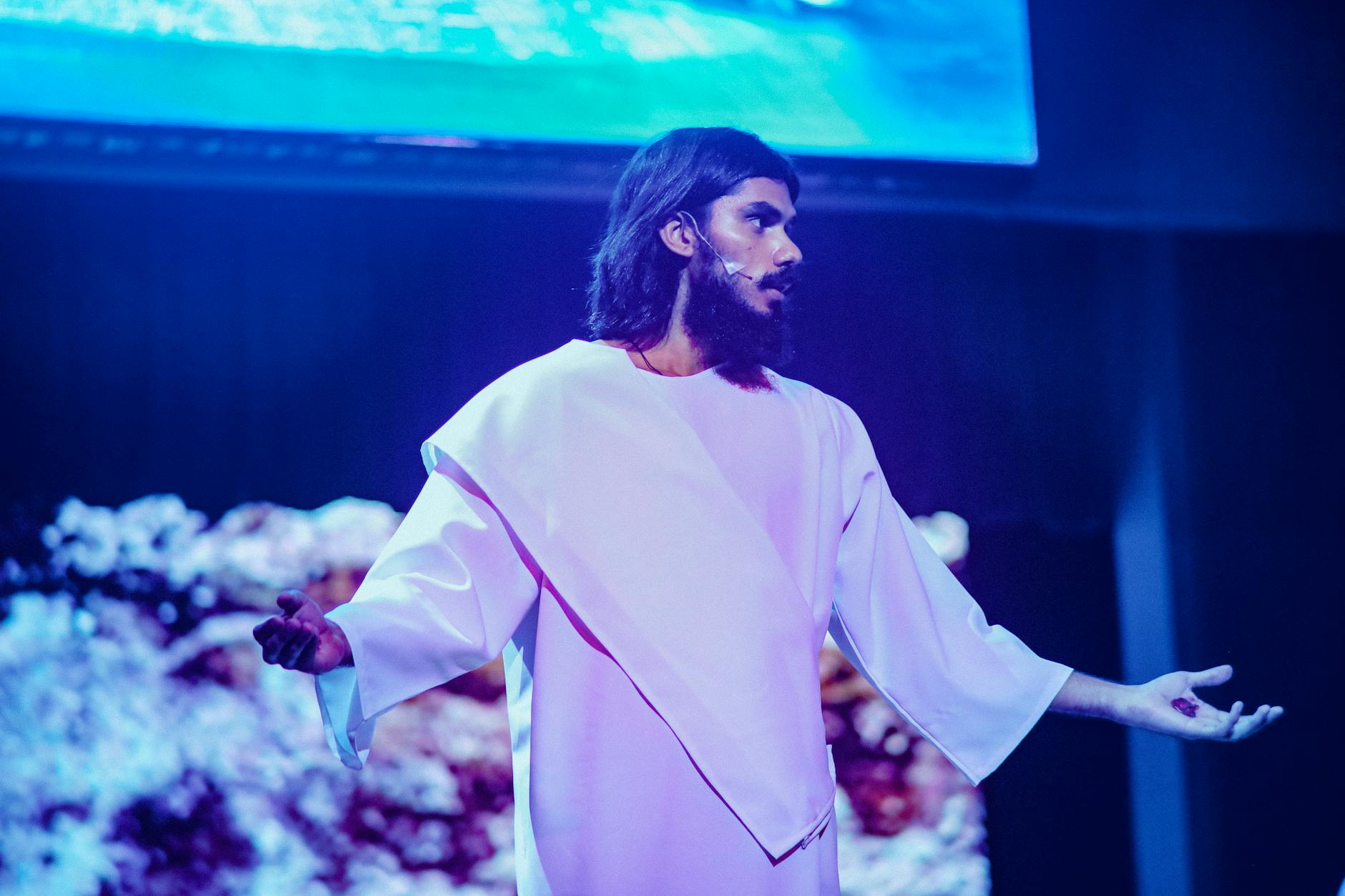
At my church growing up, Easter was an event.
Not just Sunday morning services. I’m talking full-scale theatrical production, like small-town Broadway with a crucifixion. We called it an Easter play, but really, it was a full-blown Passion drama — complete with billboards along the highway featuring my sister on Jesus’ lap, men in the congregation growing out their beards for historical accuracy, and a backstage makeup crew armed with fake blood and latex scars like a low-budget horror film masquerading as salvation.
The sanctuary would transform into ancient Jerusalem. Lights dimmed. Smoke machines puffed out an eerie haze. Roman soldiers stomped around in homemade armor. I can still hear the clank of their plastic spears on dowels against the grey-carpeted plywood stage. And then there was Jesus — usually played by the same middle-aged volunteer every year, my friend’s dad Jim, who somehow managed to look both exhausted and radiant under the spotlight as they lashed him and led him to the cross he had just carried through the audience.
Musical numbers were woven throughout, of course. These weren’t your tame, soft-rock worship hits. (Although we definitely included Avalon’s timeless CCM banger, “Testify To Love”) These were operatic, full-throated ballads about blood, sacrifice, and salvation. High drama. Choir robes swaying. And every spring, as the trees outside the church began to bud and bloom, those songs would crawl back into my head like ghosts of Easter past.
We didn’t just perform it once, either. No, we ran it for a full weekend, sometimes longer. And after the play wrapped, we’d leave the cross standing at the front of the church like a trophy. For weeks afterward, during regular services, it loomed there — scarred, splintered, stained — casting its shadow over every sermon, every song.
I remember sitting there as a kid, sandwiched between my friends, half-distracted by thoughts of holding hands with one of the girls in the youth group, sneaking glances during altar calls. Hormones and holy fear mixed together in a strange cocktail of confusion.
But beneath my adolescent daydreams, another thought kept gnawing at me.
Why did it have to be this way?
Even as a kid, part of me wondered why the story was written in blood. Why the whole spectacle — the torment, the torture, the grotesque display of violence — was presented as good news. Why God, who supposedly loved us beyond comprehension, needed so much suffering to be satisfied.
I didn’t have the words for it then. I just knew something felt off.
Now, all these years later, I’ve started to understand what that feeling was.
It wasn’t doubt.
It was an invitation.
That invitation would take years to answer. But eventually, it led me to question everything I thought I knew about the cross.
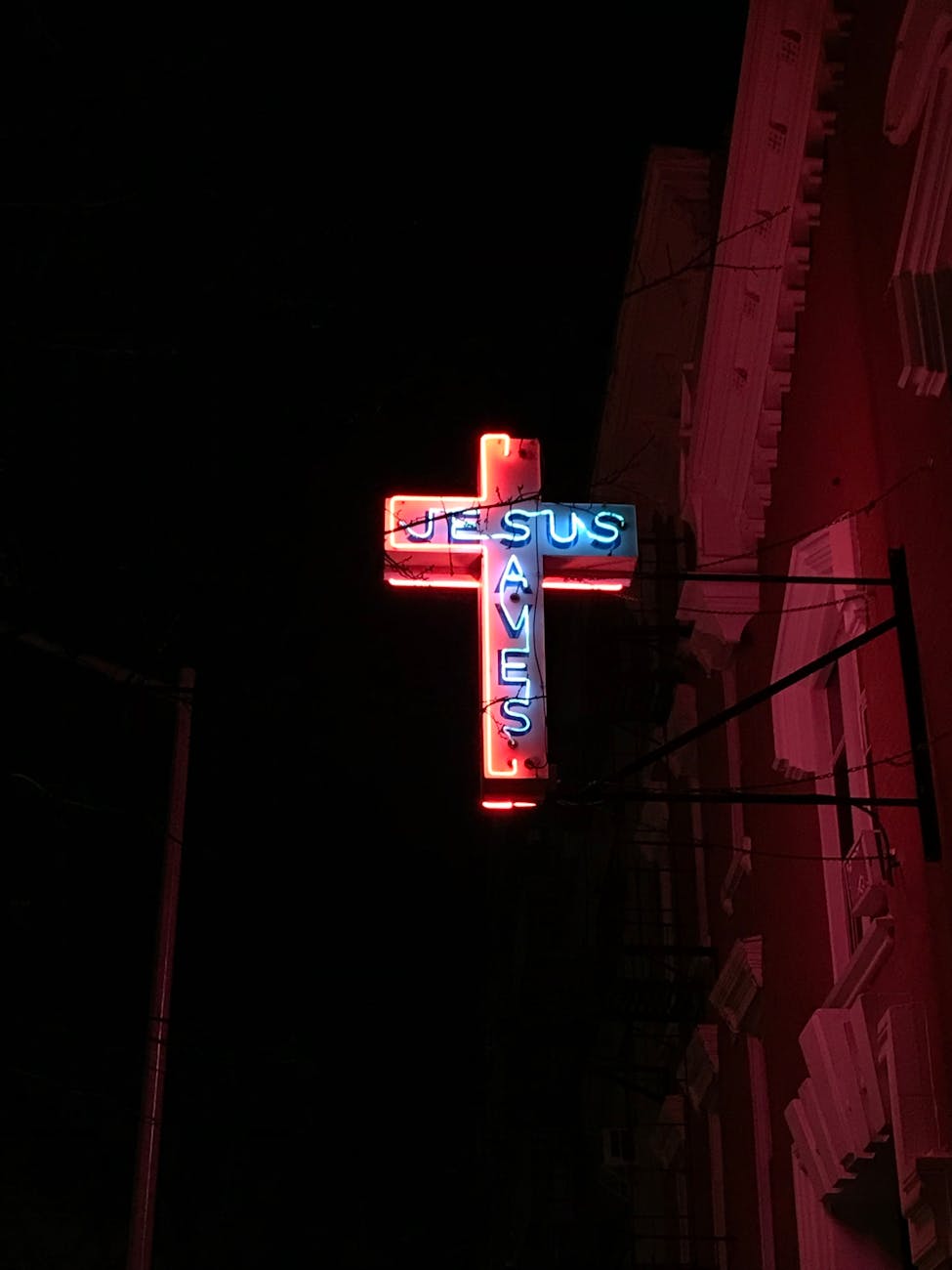
I grew up believing the cross was God’s “Plan A”.
That from the dawn of time, God had been building toward this gruesome, brutal solution to the problem of human sin. That our rebellion was so total, so cosmic, that the only way for God to stomach our existence was to watch His own Son be tortured to death like a common criminal.
They told me this was love.
But I remember staring at the blood-stained cross in the sanctuary, week after week, and feeling something under my ribs tighten. Not reverence. Not relief.
Grief.
Confusion.
A quiet, trembling sense that something here didn’t fully add up.
Because if God is love… real love, unconditional love, not transaction-in-disguise love… then why the need to demand blood at all? Why set up a system of cosmic justice that could only be balanced by violence? Why build a universe that requires innocent suffering to fix what fear and separation broke?
The deeper I went, the harder it became to reconcile the claim that Jesus’ death was necessary with the belief that God is, at essence, goodness itself. Not just good “to us,” but good at His very core level of being.
And it turns out, the language had been whispering to me the whole time. I just didn’t know how to listen.
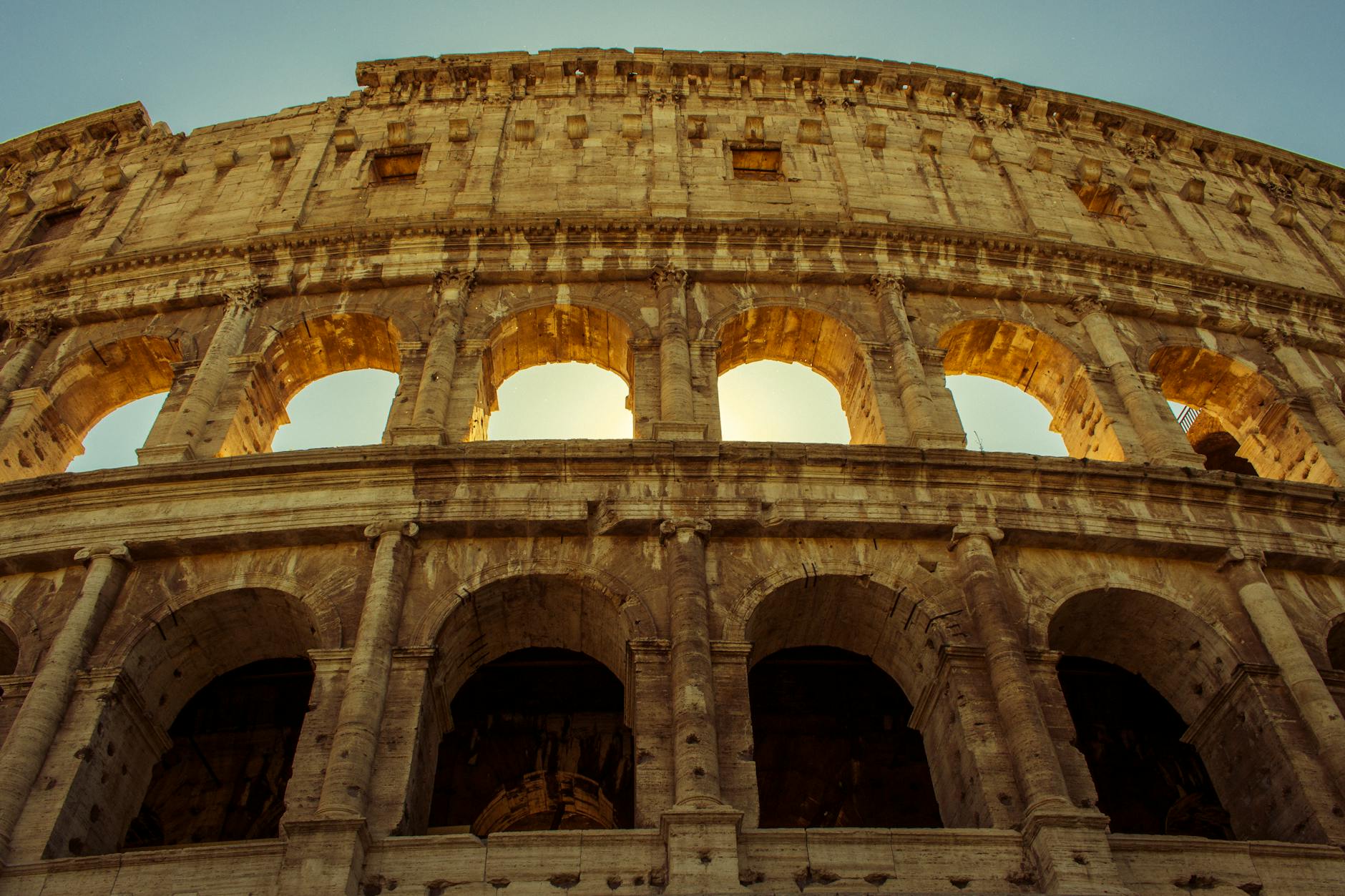
See, we inherited a story shaped not just by scripture, but by centuries of empire. Empire loves blood sacrifice — because empire lives by the sword and dies by the sword. Empire loves a violent god, because it justifies its own violence.
But buried beneath the empire’s version of the gospel is an older song.
Take atonement, for example. We were taught it meant appeasing God’s wrath. But the English word comes from “at-one-ment.” Union. Restoration of relationship.
Or repentance. The Greek is metanoia — not groveling, but a change of mind. A widening of perception. A turning toward the light.
And in Hebrew, there’s teshuvah — not a groveling apology, but a return. A homecoming. It literally means “to turn back,” not toward punishment, but toward the Source of life itself. Teshuvah is the art of remembering where we belong, of finding our way back to wholeness when we’ve lost the path. (I wrote about it at length in this blog post a few weeks ago.)
Even sin. The Greek hamartia means “to miss the mark.” Not a legal violation deserving execution or bloodshed, but a distortion of aim. A sickness needing healing, not punishment.
And sacrifice? Long before it became code for slaughter, the Latin roots point to “to make sacred.”
To make sacred.
What if Jesus didn’t die to satisfy God’s demand for violence, but to make sacred even the ugliest parts of our human story? To enter into the belly of the beast — into the empire’s machine of war, death, and brutality — and expose it for what it really is?
A sham.
A system built on fear, fed by scapegoats, perpetuated by people too terrified to imagine another way.
The cross was never Plan A.
Plan A was — and always has been — union.
Plan A was the Garden. Walking together in the cool of the day. No separation, no shame, no sacrifice needed.
Plan A was breath. Spirit. Ruach. The animating presence of God in all things.
But we lost our way. Not because God demanded blood, but because we did. We built religions of fear and altars of violence, believing that blood would keep the gods at bay.
And Jesus — Yeshua — stepped into our madness not to affirm it, but to dismantle it from the inside.
To let it exhaust itself on his body.
And then, to rise from the grave, holding out his wounds not as receipts of divine satisfaction, but as evidence of our deliverance from the system we thought would save us.
The cross is not a transaction.
It’s a revelation.
A revelation of what happens when divine love collides with human fear.
And a revelation that, in the end, love always has the last word.
I’ll be unpacking this more in my next post: Does God Need Blood?
But for tonight, let this question linger:
What if the cross was never Plan A?
What if God’s original plan was never punishment, but participation?
Never condemnation, but communion?
And what if the resurrection is not God’s bailout of a broken system, but the unveiling of a love, miraculous and powerful, that has been beneath it all, waiting to be discovered?
We’ll go there.
Soon.
Stay tuned.
Thanks for taking the time to read my blogs! I’d love it if you subscribed or left a comment, especially if something resonates with you or if your church had an easter play and I brought up some memories! -JD



 The Way of the Source
Leave a comment